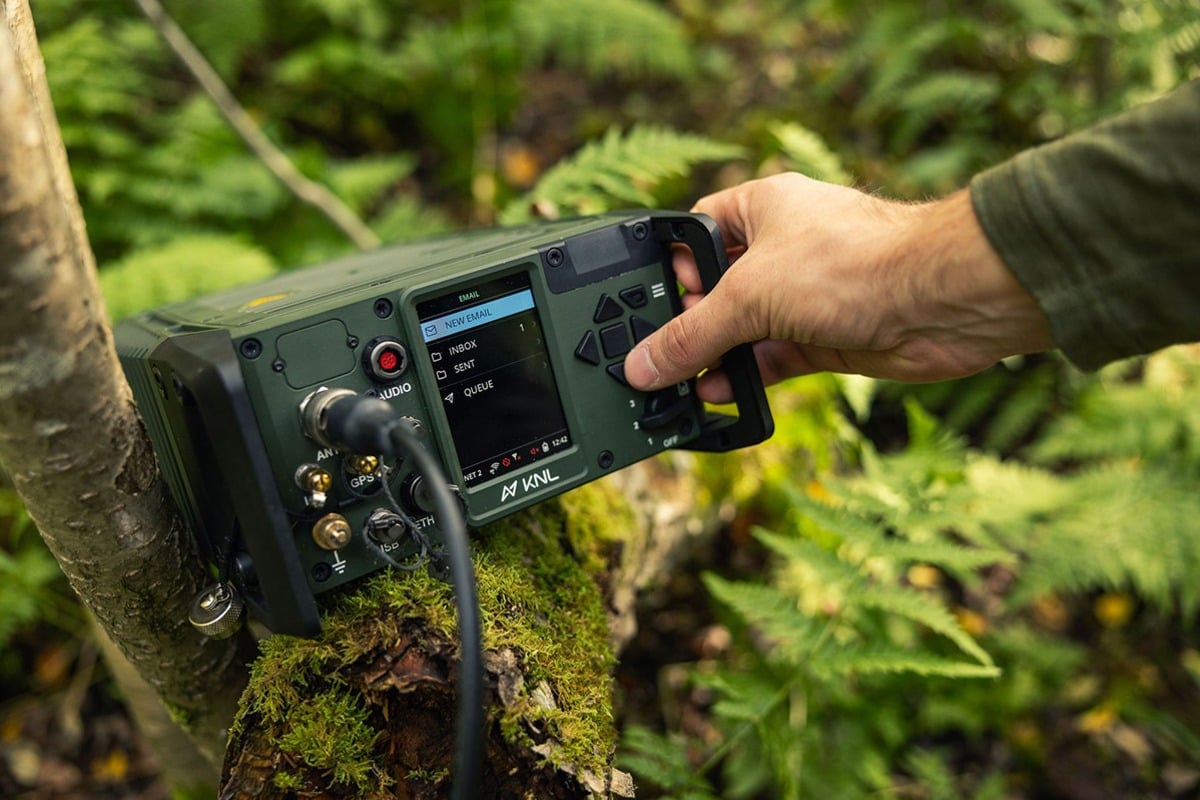
The British Ministry of Defence has quietly admitted that its long-standing approach to frontline communications needs an injection of foreign expertise. By placing Finnish defense technology firm KNL onto its multi-billion-pound Tactical Communication Systems Framework (RM6393), Whitehall is signaling a major shift in how NATO allies plan to talk to each other during a major conflict. The massive umbrella framework, which holds a maximum face value of up to GBP 5.4 billion over an eight-year period across its primary subsystems and components lots, is not just another routine government procurement order. It represents a calculated attempt to fix a systemic vulnerability in Western military infrastructure.
For decades, major military powers assumed that satellite networks and cellular-based theater systems would handle the heavy lifting of modern data transmission. Ukraine changed that calculation. Electronic warfare and widespread satellite jamming have forced planners to look backward to move forward. The future of tactical command and control relies heavily on modernizing high-frequency (HF) radio technology, a medium once left for dead after the Cold War.
The Ghost in the Static
Traditional military radio communications suffer from a fundamental flaw. They are easily intercepted, jammed, or blocked by terrain. If a commander in the field cannot reach headquarters, the entire operational loop breaks down.
During the global war on terror, Western militaries operated in environments where they controlled the electromagnetic spectrum. Satellites provided constant coverage, and troops used data-heavy applications without fear of disruption. A conflict with a peer adversary removes that luxury entirely. Low Earth orbit satellites can be blinded, and local cellular networks can be spoofed or obliterated within the first hour of hostilities.
This reality explains the sudden resurgence of interest in HF radio. Unlike line-of-sight ultra-high-frequency signals or satellite links, HF signals bounce off the Earth's ionosphere. This allows them to travel thousands of kilometers, bypassing mountains and oceans without needing an orbital middleman.
[Tactical Radio Transmission] ---> [Ionosphere Reflection] ---> [Over-the-Horizon Receiver]
                                         |
                                (Satellite Jammed)
Yet, old-fashioned HF was notoriously finicky. It required skilled operators to constantly manually tune frequencies, hunt for clear channels amid crackling static, and adapt to solar activity that alters atmospheric conditions.
The Finnish solution treats the ionosphere not as an unpredictable obstacle, but as a dynamic data highway. KNL utilizes what the industry calls Cognitive Networked HF. Instead of an operator manually searching for a clear channel, the radio system digitizes the entire available spectrum simultaneously. The hardware evaluates the signal environment in real time, automatically shifting data packets to the cleanest available frequencies faster than a human ear could ever detect the switch.
The Sovereignty Dilemma in NATO Supply Chains
Selecting a foreign vendor for critical defense infrastructure always triggers intense debate inside the Ministry of Defence. The UK boasts its own historic defense manufacturing ecosystem, yet Whitehall chose to open its premier tactical framework to an outfit based in Oulu, Finland, which operates under the corporate umbrella of Norway's Telenor Group.
This choice reflects a broader trend within NATO procurement. The alliance is grappling with the harsh reality that no single nation can maintain a closed-loop supply chain for every component of modern warfare. The British military is prioritizing proven operational utility over domestic industrial protectionism.
Finland has spent decades preparing for highly contested, cold-weather electronic warfare scenarios along its extensive border with Russia. Their defense industry did not experience the same post-Cold War developmental lull that affected UK and US tactical radio programs. While British procurement cycles became bogged down in endless requirements shifts and bureaucratic overhauls, the Nordics quietly perfected software-defined, self-optimizing radios designed specifically to withstand intense electronic suppression.
The British military is leveraging this ready-made expertise to bridge an immediate capability gap. KNL secured positioning on both Lot 2 for full communication systems and Lot 3 for specialized components. This dual placement allows the British Armed Forces to buy complete radio sets for immediate deployment or purchase specific sub-assemblies to upgrade existing hardware built by traditional domestic prime contractors.
The Illusion of the Big Budget Contract
When headlines trumpet billions of pounds in defense frameworks, the public often assumes a massive check has been signed and trucks loaded with gear are heading for military bases. The reality of defense procurement is far more conservative.
A framework agreement is not a guaranteed purchase order. It is simply an administrative hunting license. By gaining entry to the RM6393 framework, the Finnish firm has cleared the rigorous security, technical, and financial vetting required to pitch directly to British military units. They have a seat at the table, but they still must compete for individual task orders against established defense giants.
This arrangement serves as an internal defense mechanism for taxpayers and military planners alike. It prevents the Ministry of Defence from locking itself into a single vendor that might fail to deliver on schedule. If the Finnish tech underperforms during field trials with British personnel, the Ministry can route funding to another supplier on the framework.
Conversely, it forces entrenched domestic suppliers to keep their prices realistic and their technology competitive. For years, major defense primes enjoyed a captive market in Whitehall, frequently delivering projects years late and over budget because the government had no viable alternative. Introducing nimble, specialized players from the Nordic region disrupts that comfortable dynamic.
Beyond the Battlefield Horizon
The integration of cognitive radio systems into the British military signals a broader tactical shift toward distributed command structures. Modern warfare moves too fast for centralized commands to filter every decision through a distant headquarters via slow satellite links. Small units must operate independently, frequently cut off from the broader network, while still maintaining the ability to pass critical targeting data over long distances.
If a specialized radio can transmit secure, low-bandwidth data across continents without relying on satellite infrastructure, the entire calculation of electronic deterrence changes. An adversary can jam the sky, but they cannot easily eliminate the ionosphere.
This procurement strategy shows that the UK is preparing for a fractured, chaotic combat environment where survival dictates simplicity and resilience over fragile complexity. The contract awards over the next twenty-four months will reveal exactly how quickly the British Army intends to phase out its aging legacy equipment in favor of these intelligent Nordic networks.