The steel of a warship does not just displace water. It displaces peace.
When sixty thousand tons of militarized engineering slides through the Miyako Strait, it does so with a silence that belies its true noise. You cannot hear it from the rocky shores of Okinawa, and you certainly cannot hear it from the bustling neon-lit alleys of Tokyo. But on the radar screens of the Japan Maritime Self-Defense Force, that silence screams.
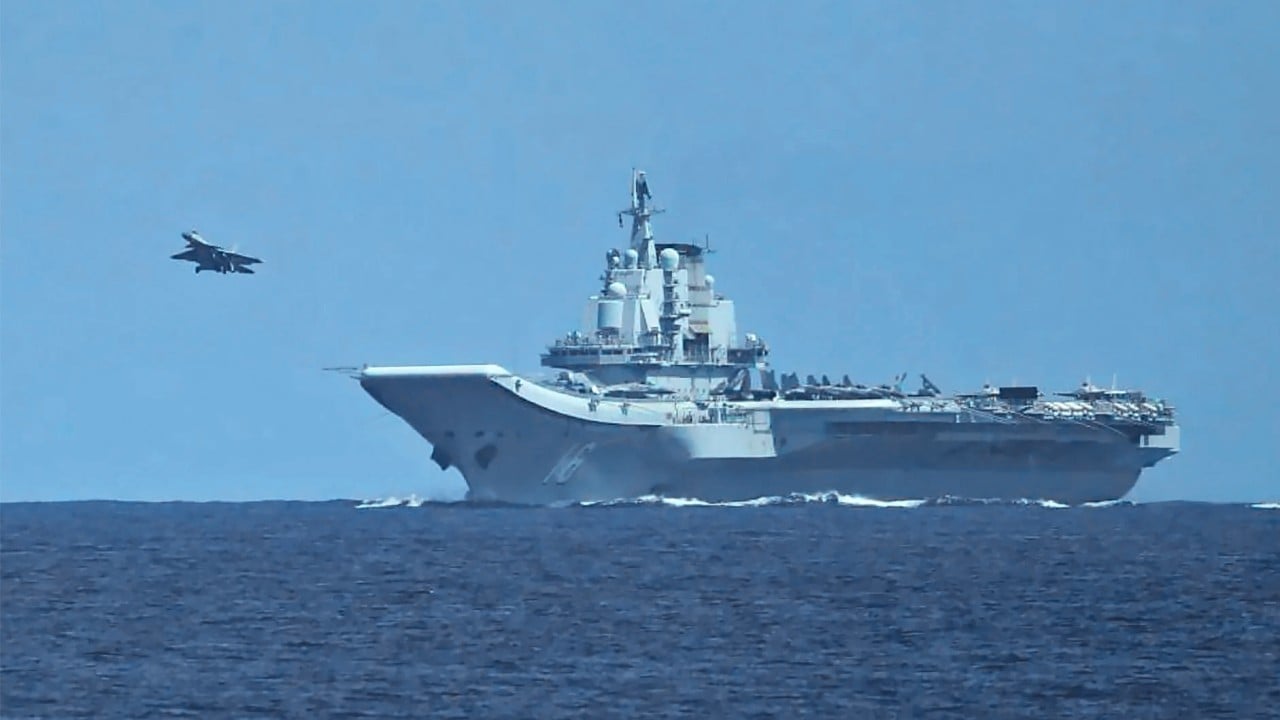
Looming out of the gray mists of the Western Pacific, a Chinese aircraft carrier strike group cuts through the waves. To the analysts reading the satellite feeds, it is a data point—a collection of coordinates, speeds, and hull classifications. But to anyone who understands the fragile geometry of the region, it is something entirely different. It is a physical manifestation of a changing world order, happening one nautical mile at a time.
To understand what is happening out there in the deep blue, we have to step away from the sterile language of press releases. We have to look at the people who watch the screens, the history that haunts the waters, and the invisible lines drawn across the ocean that no one is allowed to cross.
The View from the Scope
Think of a young radar technician stationed on a Japanese destroyer patrolling the East China Sea. Let us call him Kenji. Kenji is twenty-four, fueled by canned coffee from a shipboard vending machine, staring at a glowing monitor in a room that smells of ozone and recycled air.
For months, his world has been a predictable rhythm of fishing trawlers, commercial cargo vessels, and the occasional routine patrol boat. Then, the blips change.
They are moving in formation. A massive central hub surrounded by a protective ring of guided-missile destroyers and fast combat support ships. This is not a casual transit. This is a carrier strike group, a floating city capable of launching lethal force at a moment's notice, operating right in Japan’s backyard.
When these exercises begin, the air inside the command center thins. Every turn of the Chinese carrier’s rudder is tracked. Every time a fighter jet spins its turbines on the flight deck, a dozen counter-mechanisms blink to life across the horizon. Japan scrambles its own jets. Scramble. It is a frantic word for a highly disciplined action, but it captures the underlying anxiety. Pilots sprint to their aircraft, engines roar to life, and human beings lift off into the sky to stare down other human beings through the cockpit glass of rival machines.
This is the choreography of deterrence. It is a high-stakes game of chicken where the participants must remain entirely cold-blooded. One miscalculation, one overeager pilot, or one technical malfunction could turn a routine show of force into an international crisis.
The Island Chain and the Choke Point
Why this specific patch of ocean? To understand the tension, we must look at the map not as a tourist does, but as a naval strategist does.
China’s coastline is boxed in. A geographic crescent of islands—stretching from Japan through Taiwan down to the Philippines—creates a natural barrier known as the First Island Chain. For decades, this chain has acted as an invisible wall, keeping the Chinese navy confined to its immediate coastal waters.
But a superpower cannot be contained forever.
The Miyako Strait is a narrow body of water passing between Japan's Okinawa Island and Miyako Island. It is one of the few international gateways through that island chain. It is a geographic choke point. When the Chinese carrier group sails through it, they are flexing their muscles, proving they can break out into the vast expanse of the deep Pacific whenever they please.
For Tokyo, this is deeply unsettling. Japan is an island nation. It relies almost entirely on open sea lanes for its energy, its food, and its commerce. If those lanes can be dominated by a neighbor with historical grievances, Japan’s sense of security evaporates.
The relationship between Tokyo and Beijing has always been a bruised nerve. The ghosts of the twentieth century still walk the halls of diplomacy. When China increases its military footprint in these waters, it isn't just practicing tactics. It is sending a psychological message to Japan: The old balance of power is dead.
The Machinery of Ambition
We often talk about aircraft carriers as symbols, but they are marvels of terrifying utility. Building a blue-water navy—one capable of operating across deep oceans far from home ports—is the ultimate test of a nation's industrial and technological might.
It requires a mastery of logistics that defies imagination. A carrier must be fed. It needs thousands of tons of aviation fuel, fresh water, food, and ammunition. It requires a flawless synchronization of radar, satellite communication, and anti-submarine warfare systems.
For years, critics dismissed China's naval ambitions as a paper tiger. They laughed at their first carrier, a refurbished Soviet hull purchased under the guise of becoming a floating casino. But nobody is laughing now.
Beijing has built a massive shipbuilding apparatus that turns out advanced warships at a pace the world has not seen since World War II. They have refined their carrier operations, moving from tentative coastal cruises to complex, multi-ship drills in the treacherous waters of the open Pacific. They are learning how to fight in the dark, how to operate under intense electronic interference, and how to project power thousands of miles from their shores.
This rapid expansion forces Japan into a difficult corner. By its own constitution, Japan’s military is a self-defense force. Its posture has historically been reactive, defensive, and deeply cautious. Yet, the sheer scale of the Chinese naval buildup is forcing Tokyo to rethink everything. They are buying stealth fighters, upgrading their own destroyers to carry aircraft, and increasing defense spending to levels unseen in generations.
An arms race in the Pacific is no longer a future prediction. It is the current reality.
The Quiet Room in Tokyo
Away from the spray of the ocean, the real decisions are made in quiet, wood-paneled rooms in Tokyo. Here, senior officials sit with maps spread across heavy tables. They know that this is not just about a single exercise or a specific deployment of ships.
It is about vulnerability.
The Japanese public has long enjoyed a peaceful insulation from the harsh realities of global geopolitics. But that insulation is wearing thin. Every time an alert sounds because a foreign fleet is operating near their territorial waters, the reality sinks in a little deeper. The world is getting smaller, louder, and much more dangerous.
The strategy for Japan is a delicate tightrope walk. They must show strength without provoking a conflict. They must coordinate closely with their American allies while avoiding actions that make an escalation inevitable. They must defend their sovereignty without slipping into the trap of hyper-nationalism.
It is a terrifyingly complex calculation. There are no easy answers, no simple solutions that can be written down on a single sheet of paper. There is only the daily, grinding work of monitoring, adapting, and hoping that deterrence holds for one more day.
What Rests Beneath the Waves
The true weight of this confrontation is felt most acutely at night.
Imagine being on the deck of a Japanese destroyer at 3:00 AM. The wind is howling off the Pacific, carrying a bitter chill. The water is pitch black, a vast, consuming void. Somewhere out there, just beyond the horizon, the lights of the Chinese carrier strike group are dimmed. They are moving through the dark, a massive entity of steel and human intent.
You cannot see them with your eyes, but you know they are there. You can feel the vibration of their presence through the hull of your own ship.
This is where the grand theories of international relations meet the cold reality of human existence. The sailors on both sides of that invisible line are young. They have families waiting for them in ports hundreds of miles away. They are terrified, proud, tired, and focused. They are the instruments of empires, placed in a position where a single mistake could change the course of history.
The ocean has a way of swallowing things. It swallows ships, it swallows secrets, and it swallows the memories of those who fought across its surface. As the Chinese fleet concludes its drills and turns back toward the mainland, the wakes of the ships begin to smooth over. The white foam dissolves back into the deep blue.
The water looks exactly as it did before they arrived. Clean. Empty. Still.
But the peace has changed. It is heavier now, burdened by the knowledge of what just passed through, and the certainty of what will eventually return.