The human body is mostly water, but under a collapsed ceiling, it becomes a clock. Tick. Tick. Tick. With every hour that passes in total darkness, the odds of survival do not just drop; they plummet off a cliff. By the time one hundred and forty-four hours have ticked away, the statistics stop being numbers and become a death sentence.
Yet, beneath the crushed concrete of a Venezuelan town shattered by successive earthquakes, forty-three-year-old Orlando Moreno was still breathing.
To understand what happened in those six days is to look directly into the most terrifying, resilient corners of human nature. It requires us to move past the dry wires of the evening news—which flatly reported a rescue nearly a week after the tremors—and step into the dust, the heat, and the silence.
The Sound of the Earth Breaking
When the earth shifts beneath Venezuela, it does not do so with a warning. It happens in an instant of violent, grinding noise. Walls that have stood for decades turn to liquid and ash in seconds.
For Orlando, the world contracted into a space no larger than a coffin.
Imagine the immediate aftermath of a catastrophic collapse. The dust is so thick it feels like swallowing concrete. It coats the throat, blocks the nostrils, and turns the act of breathing into an agonizing chore. In those first few minutes, panic is the real killer. The heart races, demanding oxygen that is rapidly running out in a confined pocket of air.
Medical experts often talk about the "Rule of Three" when discussing survival: three minutes without air, three days without water, three weeks without food. But the Rule of Three is a clinical abstraction. It does not account for the sheer weight of a collapsed building pressing down on the air around you. It does not account for the terrifying, total absence of light.
True darkness is not the darkness of a bedroom at night. It is an active, heavy entity. It tricks the eyes into seeing shapes that are not there and stretches minutes into what feel like infinite loops of time.
The Mathematics of Miracles
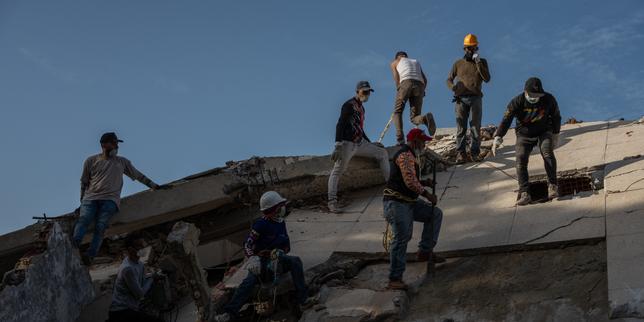
Outside, the world was a chaotic symphony of sirens, shouting, and the heavy thud of manual labor. Rescue teams, strained by the scale of the destruction across the region, worked against a timeline that grew bleaker with every setting sun.
In disaster response, the first seventy-two hours are considered the critical window. During this phase, search and rescue operations are frantic, fueled by the realistic hope of finding survivors. But as that third day bled into the fourth, then the fifth, the nature of the operation subtly shifted. It became a recovery effort. The heavy machinery moved in. The tone of the workers grew quiet, somber.
They were looking for bodies, not miracles.
Consider the physical reality Orlando was facing during those ninety-six, then one hundred and twenty hours. Dehydration is a slow, agonizing process. The tongue swells. The skin loses its elasticity. The kidneys, desperate to preserve fluid, begin to shut down, sending toxic waste back into the bloodstream. Hallucinations are almost guaranteed. The mind, desperate to escape the reality of the stone tomb, constructs vivid dreams of running water, of open fields, of the faces of loved ones.
But the body possesses an ancient, stubborn code. When external resources dry up, it begins a brutal internal triage. It slows the metabolism. It sacrifices non-essential functions to keep the heart pumping and the brain firing. It is a terrifyingly beautiful design, a testament to millions of years of survival encoded into our very cells.
The Moment the Concrete Spoke
On the sixth day, a rescue dog caught a scent. Or perhaps a worker, pausing to wipe sweat from his brow, caught the faintest sound of a hollow scrape.
The rescue of Orlando Moreno was not a cinematic explosion of triumph. It was a tedious, agonizingly careful extraction. One wrong move, one displaced piece of rebar, and the unstable pocket holding him would have collapsed like a house of cards.
Rescuers used their bare hands, clawing through the gray grit, passing buckets of debris back along a human chain. They were fighting against the very laws of probability. When they finally broke through, they found a man who had survived six days in a space that should have been his grave.
He was severely dehydrated, bruised, and covered in a thick layer of pulverized mortar, but he was alive. As the medical teams rushed him to a waiting ambulance, his eyes were shielded from the harsh tropical sun—eyes that had not seen a single photon of light in nearly a week.
Beyond the Dust
We live in a world obsessed with certainty, data, and predictable outcomes. We read headlines about natural disasters, shake our heads at the tragedy, and move on to the next digital distraction. We treat these events as distant anomalies.
But stories like this shatter that complacency. They remind us that beneath the fragile surface of our daily routines lies a profound, untamed will to endure. Orlando Moreno’s survival is a stark reminder that life does not always surrender to the statistics printed in medical textbooks or disaster manuals.
Sometimes, against all logic, the clock stops ticking, and the dark has to give them back.