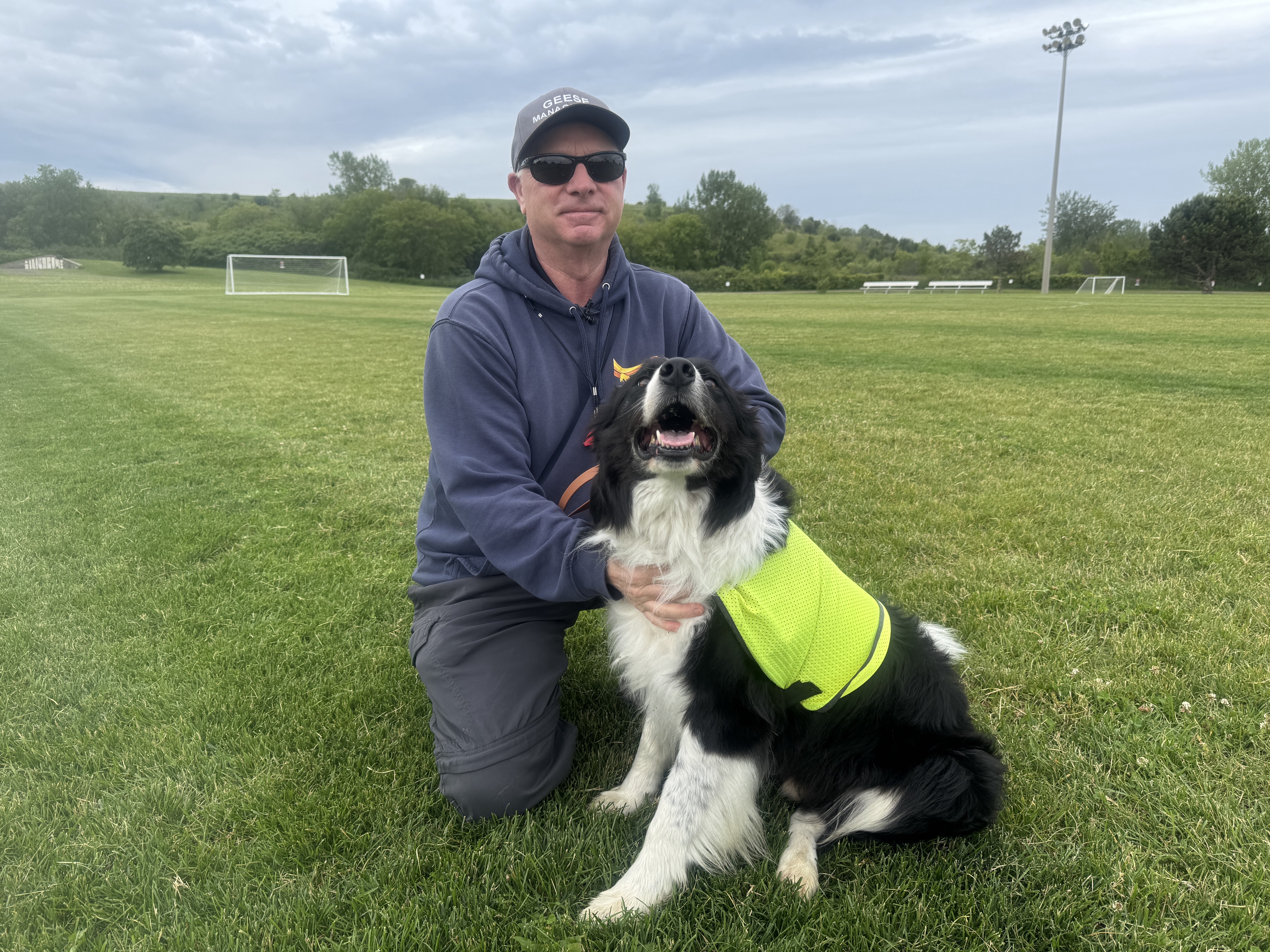
The grass at a FIFA training complex does not look like regular grass. It looks like velvet. It is manicured to a height of exactly twenty-four millimeters, watered to a precise percentage of soil moisture, and guarded like a vault. On any given morning, millions of dollars in human athletic capital will step onto this turf. A single slip, a stray pebble, or an uneven patch can tear an anterior cruciate ligament, altering the trajectory of a World Cup and erasing years of national hope.
But nature does not care about broadcast rights or shoe contracts.
Before the mist even rises off the pitch, the true adversaries arrive. They descend from the sky in V-formation, heavy-bodied and loud. Canada geese. To the average park-goer, they are a minor nuisance. To the groundkeepers of elite sport, they are an absolute catastrophe.
A single goose can drop up to two pounds of manure a day. Multiply that by a flock of fifty, and within forty-eight hours, a pristine multimillion-dollar pitch becomes a slick, hazardous minefield of bacteria, parasites, and slippery mud. Mechanical scarifiers tear up the delicate hybrid turf. Chemical deterrents are toxic to the environment and forbidden near elite athletes. Laser systems work only in the dead of night, and the birds eventually learn to ignore them.
When technology fails, the world's biggest sporting organization has to look backward, relying on a partnership that predates modern athletics by thousands of years.
The Precision of the Threat
Consider the physics of a modern soccer player. A winger cutting inside at twenty miles per hour places immense lateral force on their ankles and knees. The boots are designed to grip the turf perfectly, sliding just enough to prevent joint shearing but holding firmly enough to allow explosive acceleration.
Now introduce goose droppings.
The substance is slick, high in nitrogen, and incredibly corrosive to grass. More importantly, it creates a friction vacuum. If a player plants their foot on a contaminated patch of turf, the boot loses traction instantly. The knee twists. The ligament snaps.
For years, tournament organizers tried everything to secure these sensitive perimeters. They installed plastic coyotes. The geese sat on them. They blasted recorded distress calls. The geese grew accustomed to the noise within a week. They hired human crews with brooms and rakes, but manual labor is slow, and the birds simply circle back the moment the workers turn their backs.
The problem is cognitive. Geese are highly intelligent, stubborn, and deeply territorial. They quickly realize when a threat has no real intent behind it. A plastic decoy never moves. A recorded sound never bites. To clear a pitch permanently, you need an active, living intelligence that speaks the ancient language of predators.
Enter the Border Collie Eye
Imagine standing at the edge of the pitch at 5:00 AM. The air is freezing. Beside you sits a three-year-old Border Collie named Pip. She is not barking. She is not pulling on her lead. Her entire body is coiled like a spring, her eyes locked on a flock of thirty geese grazing near the penalty box.
Pip does not see a bird. She sees a job.
Her handler, let us call him Thomas, stands quietly. He does not yell. He uses a specialized brass whistle held between his teeth, emitting a sharp, dual-tone command.
Pip drops her belly to the dew-soaked grass. She begins to move.
Unlike hunting dogs or terriers, a specialized bird dog used for goose management does not attack. Violence is a failure of the system. If a dog harms a goose, it violates federal migratory bird laws and creates a public relations nightmare outside the stadium gates. Instead, the Border Collie uses what herders call "the eye."
It is a low-crawl approach, mimicking the exact stalking profile of an apex predator like an arctic wolf. The dog moves in a zig-zag pattern, never rushing directly at the flock, slowly cutting off their escape routes to the open water or the nearby tree line.
The geese watch. They recognize the posture. The plastic coyotes never crouched like this. The stadium workers never moved with this terrifying, fluid intent. The flock begins to murmur. Their heads lift. The dominant gander steps forward, hissing, flapping wings that span five feet across.
Pip does not blink. She holds the line, moving forward one inch at a time, entirely silent.
It is a psychological war of attrition. The gander realizes this creature is not bluffing. With a chaotic flurry of wings and panicked honking, the flock lifts off the ground, abandoning the pitch and heading toward a distant, unprotected public park.
The Invisible Infrastructure of Sport
We watch the matches on television and see a flawless spectacle. We see the bright lights, the clean lines, and the perfect bounces. It is easy to believe that this perfection is entirely automated, a product of modern engineering and corporate budgets.
The reality is far more fragile.
The success of a massive international tournament rests on these strange, quiet interventions. While the players are asleep in their five-star hotels, a small team of handlers and dogs are walking the perimeters, reading the wind, and managing the local wildlife.
It requires an immense amount of training. A standard farm dog cannot do this work. A pitch-clearing dog must possess a flawless recall. They must be able to stop mid-sprint on a dime, even if a fleeing goose is just inches from their nose. They must navigate expensive stadium signage, underground sprinkler heads, and complex human traffic without ever losing focus.
Thomas and Pip will repeat this routine four or five times a day. Geese are persistent; they will test the boundaries, sending scout birds to see if the predator is still on duty. But after a few days of encountering the silent, stalking shadow on the grass, the flock adjusts its migration patterns entirely. They learn that the velvet grass is a dangerous place to be.
The pitch is saved, not by machines or chemistry, but by a glance.
When the whistle blows for kickoff later that afternoon, the commentators will talk about tactics, fitness, and star strikers. No one will mention the dew-covered Border Collie sleeping in the back of an estate car in the parking lot.
But as a midfielder plants their foot hard into the turf to send a forty-yard pass down the line, their safety is secured by the fact that the grass is clean, dry, and entirely free of shadows.


