A magnitude 7.8 earthquake hits off the coast of Sarangani province, and the immediate reaction from global newsrooms is a predictable tally of numbers. As of Tuesday morning, the official death toll stands at 41. It's a tragic number, but honestly, it's completely detached from the reality on the ground in Mindanao.
If you've ever stood in a disaster zone while the earth is still actively moving under your feet, you know that the initial numbers don't mean a thing. Right now, the southern Philippines isn't just dealing with the aftermath of a massive tectonic shift along the Cotabato Trench. It's fighting a war of attrition against hundreds of relentless aftershocks that are actively dismantling whatever infrastructure survived the initial shock on Monday morning.
The real crisis isn't just what happened at 7:37 AM on June 8. It's what is happening right now, hour by hour, as rescue teams try to dig through landslides while the ground refuses to sit still.
The Cotabato Trench Just Reminded Us Who Is in Charge
The structural damage across Mindanao is massive, and blaming it solely on a single 30-second tremor misses the point entirely. The Philippine Institute of Volcanology and Seismology (PHIVOLCS) clocked the main event at magnitude 7.8, making it the strongest earthquake to hit this specific region since the catastrophic 1976 event. But the real nightmare for emergency responders is the seismic sequence following it.
We aren't talking about a few minor tremors that rattle the windows. The region has logged over 138 distinct aftershocks, with the strongest hitting a terrifying magnitude 6.7.
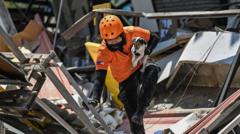
Think about that for a second. A 6.7 magnitude event is a major earthquake in its own right anywhere else in the world. Here, it's treated as a footnote—an aftershock. Every time a rescue worker crawls into the ruins of a collapsed grocery store in General Santos City or a buried home in Glan municipality, they're playing Russian roulette with a structure that's already compromised.
- Sarangani Province: 14 people dead in a single landslide after a mountainside collapsed onto homes.
- General Santos City: Commercial buildings fractured, with property damage in the port city alone estimated at 1 billion PHP ($16.2 million USD).
- Infrastructure Collapse: The national road networks are shattered. Bridges have dropped into rivers, completely isolating coastal communities in Davao Occidental.
When roads are wiped out, the only way in is by air. But civil aviation authorities have restricted General Santos International Airport to military and humanitarian flights. If you're trying to get commercial aid or private rescue teams into the zone, you're out of luck until at least June 11.
The School Calendar Disaster No One Planned For
The timing of this quake couldn't have been more brutal. Monday was the literal first day of the new academic year. After a two-month summer break, millions of children were packed into schools across Mindanao.
According to the Department of Education, the earthquake disrupted classes for over 4 million students across 8,600 schools. The worst part? The tremor struck right as kids were gathering for morning flag-raising ceremonies. Being out in the open courtyard saved some from collapsing roofs, but falling debris and stampeding crowds still injured hundreds of kids.
Step away from the macro statistics and look at the immediate human cost. At a district hospital just outside General Santos, the main building was declared structurally unsafe by municipal engineers. The solution? Doctors moved beds onto the grass outside. On Tuesday, under a blistering sun, medical staff were treating fractured bones in makeshift tents. Behind a thin plastic screen on the hospital lawn, a young mother gave birth to her baby while the ground literally trembled beneath her.
That's not a scene from a movie. That's the current reality of healthcare delivery in Davao and Sarangani right now.
Why Vague Disaster Prep Isn't Saving Lives anymore
Every time a major disaster hits the Pacific Ring of Fire, officials tell the public to do the standard "Drop, Cover, and Hold" routine. It's decent advice if you're inside a modern concrete office building in Manila. It's virtually useless when you're living in a rural barangay where the entire hillside behind your home is liquefying into mud.
The real failure isn't a lack of awareness; it's the widening gap between urban building codes and rural reality. Mindanao's power grid took a massive hit, leaving over 864,000 households completely in the dark. Without power, water pumps stop working. Without telecommunications, remote villages can't even call in their casualty lists.
If you want to understand why the death toll is guaranteed to rise, look at a map of Davao Occidental. The landslides haven't just blocked the roads; they've sealed the valleys. Rescue teams are currently forced to use light helicopters to drop basic food packs, but you can't lift a collapsed concrete slab with a light utility chopper. You need heavy earth-moving equipment, and that equipment is currently stuck behind miles of cracked tarmac and broken bridges.
What Needs to Happen Next
If you have family in the affected zones or you're looking to support the relief efforts, stop waiting for a centralized government report to give you the green light. The situation is moving too fast, and the official channels are bottlenecked.
First, prioritize satellite-based communication if you're trying to reach anyone in the Sarangani or General Santos areas. Standard cellular networks are highly unstable due to the lack of grid power and physical tower damage.
Second, if you're coordinating local aid, focus entirely on water purification tech and portable shelter. The local hospitals are stuck operating outdoors for the foreseeable future because staff refuse to step back inside cracked concrete walls—and honestly, with magnitude 5-plus aftershocks still hitting every few hours, can you blame them?
Forget long-term reconstruction plans for now. The current mission is raw survival, and until the Cotabato Trench stops sliding, every single structure in southern Mindanao remains an active hazard.