The air in the Old City doesn’t just carry the scent of cardamom and ancient dust. It carries weight. On a typical Tuesday, that weight is a quiet pressure, the kind that comes from three millennia of prayer soaked into limestone walls. But on Jerusalem Day, the atmosphere curdles. The pressure turns into a pulse.
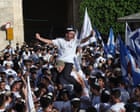
Listen to the boots. Thousands of them, rhythmic and heavy, striking the pavement of the Muslim Quarter. For the nationalist marchers, this is a victory lap, a reclamation of the "unified" city. For the shopkeepers behind the corrugated iron shutters of Damascus Gate, it is a siege they have to endure once a year, every year, until the sun goes down.
The Glass Between Two Worlds
Consider a hypothetical merchant named Omar. Omar has a small stall near the Via Dolorosa. Usually, he sells olive wood carvings and bright ceramics. On the day of the Flag March, Omar doesn't sell anything. He spends the morning drilling extra bolts into his security doors. He gathers his children in the back room.
He hears the songs before he sees the flags. These aren't hymns. They are chants that claw at the throat. "Death to Arabs." "May your village burn." The words vibrate through the metal of his door.
Across that metal barrier, there is a teenager named Itamar. Itamar is eighteen. He wears a white shirt and a knitted skullcap. He carries a blue-and-white flag that catches the wind like a sail. To Itamar, this isn't about hate; it's about belonging. He has been told since birth that this city is his inheritance, bought with blood and divine promise. When he screams those slogans, he feels a rush of power that masks a deep, inherited fear.
The tragedy isn't just the violence. It is the proximity. They are separated by two inches of steel and a thousand years of divergent sorrow.
The Geometry of a Riot
Jerusalem Day commemorates the 1967 capture of East Jerusalem. To the Israeli Right, it is the greatest miracle of the twentieth century. To the Palestinian residents of the city, it is the anniversary of an occupation that never ended.
The march follows a predictable, jagged geometry. It begins in the western part of the city, a sea of white and blue flooding the streets. It swells at the walls of the Old City. Then, it funnels. The police, draped in tactical gear, create "sterile zones." This is the official term for clearing Palestinians off their own streets so the march can pass through.
Tension. Snap.
It starts with a water bottle thrown from a rooftop. Or a slur shouted too close to a doorway. Then come the stones. Then the pepper spray. The Israeli police, caught in the middle of a demographic collision, often lean toward the marchers. They are there to "maintain order," but order is a subjective concept when one side is celebrating a conquest and the other is mourning a loss.
In the 2024 and 2025 iterations of this march, the rhetoric reached a fever pitch. Government ministers—men with the power to draft laws and command budgets—joined the crowds. When a lawmaker dances to a song about burning villages, the song stops being a fringe outburst. It becomes a policy statement.
The Invisible Stakes
Why does a march through a few narrow alleys matter to the rest of the world?
Jerusalem is a pressure cooker for the entire Middle East. When the Old City shakes, the tremors are felt in Gaza, in Beirut, and in Washington. The "Flag March" isn't just a parade; it is a recurring stress test for a fragile ceasefire.
Think of the city as a biological map. The Muslim Quarter, the Jewish Quarter, the Christian and Armenian sectors—they are organs in a single body. For most of the year, they function in a state of cold peace. They share the same electricity grid, the same sewage lines, the same bitter morning coffee.
But once a year, the "Flag March" acts like an autoimmune response. The body attacks itself.
The cost isn't just measured in the number of arrests or the stitches required for a journalist hit by a flying chair. The real cost is the erosion of the "possibility." Every time a group of teenagers enters the Damascus Gate shouting for the death of their neighbors, the idea of a shared future thins. It becomes translucent. Then it vanishes.
The Language of the Wall
Violence in Jerusalem is rarely quiet. It is loud, kinetic, and filmed from a dozen different angles on smartphones. But the aftermath is silent.
When the marchers leave and the trash is swept away, a different kind of damage remains. It’s in the eyes of the kids who watched the riot from behind the slats of a window. It’s in the way people walk the next day—faster, heads down, shoulders hunched.
There is a specific kind of exhaustion that comes from living in a place where your presence is considered a provocation. For the Palestinian residents, Jerusalem Day is a reminder that their residency is a privilege that can be suspended, while for the ultra-nationalist marchers, it is a reminder that their dominance is something that must be aggressively performed to be real.
If you stand at the Western Wall after the march has passed, you might see the remnants of the day. A dropped flag. A discarded water bottle. The stones of the wall don't care about the chants. They have heard every language, every boast, and every prayer. They have seen empires rise on the back of a "unified" city only to crumble when they forgot that a city is made of people, not just monuments.
The Echo in the Stone
We often talk about Jerusalem in the past tense or the prophetic future. We treat it as a museum or a playground for the end of the world. We forget the Tuesday mornings.
The tragedy of the "Death to Arabs" chants isn't just the racism. It is the lack of imagination. It is the inability to see that the person on the other side of the door is also waiting for the sun to set so they can breathe again.
As the sun dips below the Judean hills, the city turns a bruised purple. The police barriers are folded up. The buses take the marchers back to their suburbs. Omar opens his shop. He sweeps the stoop. He doesn't look at the Jewish neighbors who live in the reclaimed houses above the souk. They don't look at him.
The "unified" city is a map of invisible borders.
The flags are put away in closets, waiting for next year. The slogans echo in the alleys long after the voices have gone hoarse. Jerusalem remains, beautiful and broken, a place where the stones are heavy with the weight of people who love the land more than they love the people living on it.
Peace here isn't a treaty signed on a lawn in D.C. It’s the moment when a man can open his shop without checking the calendar to see if today is the day his neighbors will sing for his demise. That day was not today.
The shadows in the Old City grow long, swallowing the bloodstains and the glitter, leaving only the cold, indifferent silence of the limestone.