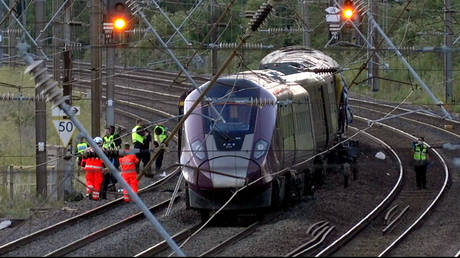
The media cycle has its script ready for the Bedford train collision. You know the routine. Sweeping helicopter shots of stationary carriages, terrifying first-hand accounts from traumatized passengers, solemn statements from politicians on social media, and an immediate, reactionary outcry demanding a multi-billion-pound overhaul of British rail infrastructure.
It happens every time a steel wheel leaves a steel rail or, in this incredibly rare case, two passenger trains make contact on the same line.
The immediate narrative is that the system is broken. Pundits claim that years of underinvestment have turned the network into a rolling hazard. Commuters vow to take their cars to work on Monday out of sheer panic.
They are wrong. Every single one of them.
The collision outside Bedford involving two London-bound East Midlands Railway services is an undeniable tragedy. A dedicated train driver lost his life, and dozens of passengers sustained injuries. But converting this isolated failure into a sweeping indictment of UK rail safety is a profound misunderstanding of statistics, risk management, and the engineering reality of modern public transport.
If you want to look at the numbers rationally instead of emotionally, this crash proves the exact opposite of what the headlines scream. It proves that the network is built to survive worst-case scenarios.
The Mirage of Dangerous Rails
Let’s dismantle the foundational premise of the outrage machine: the idea that British rail is getting more dangerous.
I have spent decades analyzing transportation infrastructure and safety logs. I have seen panicked executives dump millions into superficial safety updates just to appease a loud press pack, while ignoring real systemic issues. The reality of the UK rail network is that it remains one of the safest environments on Earth.
Before the Bedford incident, you had to look back years to find a multi-passenger fatality caused by a collision on the heavy rail network. The Rail Safety and Standards Board tracks these metrics with brutal precision. When you look at passenger fatalities per billion kilometers traveled, rail consistently performs so far ahead of any other land transport that the comparison becomes absurd.
Statistically, the most dangerous part of any train journey is the drive to the station.
Yet, when two trains collide at low speed near Bedford, the public treats it like an existential threat to modern transit. The human brain is terrible at processing relative risk. We are hardwired to fear rare, high-consequence events while completely ignoring the mundane, high-probability killers right in front of us.
Consider the sheer volume of traffic moving through the Midlands daily. Hundreds of thousands of tons of metal move at speeds up to 125 miles per hour, separated by mere minutes, guided by lines of code and physical signals. The fact that collisions are so rare that a single incident dominates the front pages for days is ironclad proof that the system works, not that it is failing.
The Engineering Victory Hidden in a Tragedy
Look closely at the footage from the Bedford crash site. Look at the actual physical state of those East Midlands Railway carriages.
The media calls it a devastating crash. An engineer calls it a structural success.
Despite two heavy trains interacting on a single track, the carriages remained upright. They did not crumple like beverage cans. They did not override each other to crush the passenger compartments below. Why? Because of modern crashworthiness standards that the public never thinks about until a bad day occurs.
UK rolling stock is designed to absorb massive amounts of kinetic energy through dedicated crumple zones and anti-climbing devices. These mechanisms ensure that if an impact happens, the force is directed away from the seating areas. The structural integrity of those carriages is the reason why, out of dozens of passengers on board, the vast majority walked away with minor injuries or no physical trauma at all.
Yes, people were thrown forward. Yes, there were broken bones and bloodied wounds. Kinetic energy has to go somewhere, and a sudden deceleration from even 30 or 40 miles per hour will cause injuries inside a vehicle without seatbelts. But the shell of the train held. The survival spaces remained intact.
The lazy consensus says this crash is an infrastructure failure. The deeper truth is that the physical assets performed exactly as they were engineered to perform during an anomaly. The train sacrificed its outer components to keep ninety percent of its passengers alive and intact.
The Signaling Scapegoat
The investigation by the Rail Accident Investigation Branch will inevitably zero in on signaling logs and dispatch records. The immediate public reaction will be to blame a lack of automation or scream for the immediate implementation of the European Train Control System across every single inch of British track.
This is where the conversation turns naive.
People think safety is a binary switch: either a system is automated and safe, or it is manual and dangerous. The truth is that automation simply shifts the point of failure from an operator's hands to a software developer's desk.
The UK already relies on highly sophisticated safety layers, such as the Train Protection and Warning System and the older Automatic Train Protection mechanisms. These systems are designed to automatically apply the brakes if a train passes a red signal or approaches a junction too fast.
Can a system fail? Of course it can. No engineering layout achieves absolute zero risk. Sometimes environmental factors interfere, such as contaminated rail heads that reduce adhesion, preventing a train's brakes from gripping the metal properly even when automatically applied. We saw this phenomenon play out in the Talerddig collision in Wales back in late 2024, where low leaf-fall adhesion caused a tragic slip.
Blaming the system for not being perfect ignores the concept of a tolerable risk threshold. If society demands an absolute guarantee of zero accidents, the only solution is to park every train in a depot and lock the gates. The cost of pursuing that final 0.0001 percent of safety would bankrupt the network, forcing millions of commuters back into cars, which would immediately cause a spike in overall transport deaths.
Dismantling the Premier Myths of Rail Safety
To understand why the public reaction to Bedford is so misguided, we have to look at the standard questions people ask after an incident like this and dismantle their flawed premises.
Does privatization make trains less safe?
This is the favorite talking point of union bosses and political commentators. They argue that separating track management from train operations creates dangerous blind spots. The data does not support this claim. Following the dark period of the late 1990s and early 2000s, the UK safety record actually improved dramatically under the post-privatization regulatory structure. Safety is governed by independent bodies, not the profit margins of private operators. The corporate structure of East Midlands Railway did not cause this accident, and nationalizing the line will not magically erase the laws of physics.
Why don't trains have seatbelts to prevent these injuries?
It seems like an obvious fix. If passengers were buckled in, they would not be thrown into the seats ahead. But transport researchers proved long ago that fitting seatbelts in trains would actually increase fatalities. In a high-speed derailment, a buckled passenger is trapped in place while the structure around them collapses or objects fly through the cabin. Leaving passengers unbuckled allows them to be thrown clear of localized crush zones, and the smooth, energy-absorbing backs of modern train seats are explicitly designed to minimize injury during secondary impacts.
Is the infrastructure too old to cope with modern demands?
The Victorian origins of the UK rail network are well documented, but the track bed, signaling blocks, and structural assets are constantly renewed. The age of a route does not correlate with its accident rate. Newer high-speed lines have different safety profiles, but the classic mainline network is subjected to rigorous ultrasound and laser testing by specialized inspection fleets every week.
The Downside of My Stance
I will admit the harsh truth about my own perspective. Taking a cold, analytical view of a train crash makes you look callous. It does not comfort a family who lost a loved one or a passenger who is recovering from a broken leg in a hospital bed.
But public policy cannot be written with tears. If we allow raw emotion to dictate how we manage transport infrastructure, we end up making knee-jerk decisions that make society less safe overall.
If the government reacts to Bedford by slowing down trains across the country or shutting down major commuter lines for indefinite safety audits, they will drive up ticket prices and extend travel times. Commuters will migrate to the highway network. More cars on the tarmac means more multi-vehicle pileups, more head-on collisions, and a net increase in the national body count.
The most dangerous thing we can do in the wake of the Bedford crash is overreact.
Stop Hunting for Villains
The public wants a villain. They want to point at a reckless executive, a sleeping signaller, or a corrupt politician to explain away the tragedy. It makes us feel safe to think that an accident only happens when someone breaks the rules.
The scarier, realistic truth is that sometimes systems fail simply because complex components interact in unforeseen ways. An unusual combination of weather, minor mechanical tolerance stack-ups, and a split-second timing gap can bypass multiple layers of defense.
We must let the investigators do their work without demanding immediate heads on pikes. The UK rail system is not a crumbling relic waiting to kill you. It is a highly resilient network that just suffered a incredibly rare, localized failure.
Step away from the sensationalized video clips on your social feed. Look at the macro data. Buy your ticket, walk onto the platform, and board your next train with complete confidence. You are participating in the safest form of land travel ever devised by human intelligence. Stop letting a hyperventilating media cycle convince you otherwise.