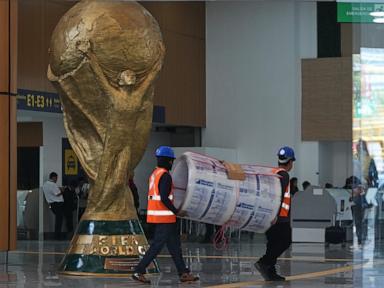
The media is currently obsessing over the wrong problem in Mexico City. Headlines are hyperventilating about Benito Juárez International Airport (AICM) racing against the clock, with thousands of workers pulling 20-hour shifts to slap fresh paint, polish floors, and install security cameras before the 2026 World Cup kicks off on June 11.
Mainstream journalists look at the $500 million price tag, the buzzing drills, and the temporary walkways in Terminal 1, and they ask: Will it be ready in time for the opening match?
That is a lazy consensus question. The real problem isn't whether the Navy-administered airport can finish laying 100,000 square meters of new flooring before the soccer fans land. The real problem is that this entire $500 million project is a masterclass in sunk-cost fallacy, designed to mask a structural disaster that no amount of cosmetic plastic surgery can fix.
I have spent decades watching governments and aviation authorities pour hundreds of millions of dollars into terminal facelifts right before major sporting events, only to watch the underlying operational bottlenecks choke the city anyway. AICM is not an airport that needs a renovation; it is a chronically constrained, landlocked airfield that should have been retired years ago.
The Illusion of Progress at 44 Slots Per Hour
The current narrative treats this $500 million renovation as a modernization initiative that secures Mexico City’s status as a premier aviation hub. It does nothing of the sort.
Let’s dismantle the actual mechanics of what is happening. The renovation focuses heavily on passenger-facing aesthetics:
- Upgraded bathrooms and polished Terminal 2 floors.
- Expanding Terminal 2 parking capacity.
- Deploying 4,000 artificial intelligence-enabled surveillance cameras.
- Reclaiming 30,000 square meters of waiting space by shuffling internal layouts.
These changes make for nice press releases, but they do absolutely nothing to solve the actual crisis of AICM: airspace saturation.
An airport's true capacity is not determined by how shiny the baggage carousels are or how many fiberglass soccer balls decorate the rotunda. It is dictated by its runways and airspace. Under the previous federal administration, available hourly slots—the specific windows allocated for aircraft takeoffs and landings—were aggressively slashed from 61 down to 43 per hour to mitigate safety risks and force traffic elsewhere. While airport authorities boast that slots will soon tick up slightly to 46, this is a drop in the bucket.
The structural reality is clear:
$$Capacity = Slots \times Average \text{ } Passengers \text{ } Per \text{ } Aircraft$$
Even if you make the waiting rooms three times larger, you cannot physically land more planes. AICM is fundamentally restricted by its two parallel runways, which are spaced too close together to allow for simultaneous independent instrument landings. A cosmetic overhaul cannot change the laws of physics or the rigidity of urban geometry.
The Ghost Airport Failure
To understand why this $500 million band-aid is so egregious, we have to look at the regional aviation strategy. The money being funneled into AICM is an admission of failure regarding the Felipe Ángeles International Airport (AIFA).
The original, economically viable solution to Mexico City’s aviation crisis was the New Mexico City International Airport (NAIM) in Texcoco. It was designed to be a mega-hub with six runways, capable of handling up to 125 million passengers annually. That project was canceled mid-construction for political reasons, leaving the city with a fractured multi-airport system that the market has flatly rejected.
AIFA, a converted military base located over 40 kilometers outside the city center, lacks the connectivity, transit infrastructure, and airline buy-in required to alleviate pressure on AICM. Because airlines refuse to split their operations and sacrifice connection logic, and because passengers refuse to endure unpredictable two-hour commutes through gridlocked highway traffic, AIFA remains vastly underutilized.
As a result, AICM is forced to handle roughly 46 million passengers a year on half-century-old infrastructure. The current $500 million renovation is not a forward-looking investment; it is emergency triage because the alternative solution failed to scale.
Dismantling the World Cup Premise
The media likes to ask: How will the airport handle the 5 million expected visitors for the tournament?
The premise itself is flawed. The tournament adds immediate public pressure, but major sporting events create a highly concentrated, artificial spike in point-to-point traffic, followed by an immediate drop-off.
Imagine a scenario where an enterprise business spends 40% of its annual capital expenditure budget exclusively to upgrade its office lobby for a two-week conference, while leaving its core servers running on legacy software from 1980. That is exactly what AICM is doing.
The airport is splitting the project into two phases. Phase one finishes right before the tournament, followed by a total construction pause, with phase two running from August through December. This operational disruption actively hurts regular business travelers and commercial cargo operations for the sake of temporary optics.
Furthermore, the introduction of advanced technologies like anti-drone systems and AI-powered passenger tracking are being rushed into deployment under compressed timelines. Anyone who has managed large-scale infrastructure deployments knows that rushing integration testing to meet a hard media deadline is a guarantee for system outages when peak load hits.
The Unconventional Blueprint For Mexico City Aviation
If throwing $500 million at a landlocked airport is the wrong move, what is the alternative? Stop trying to fix AICM's terminals. Instead, the administration needs to pivot to an aggressive, market-driven operational strategy.
1. Enforce a Strict Up-Gauging Mandate
Since runway slots are capped at a hard physical limit, the only way to move more people through AICM without upgrading terminals is to force airlines to fly larger aircraft. The authorities should implement a slot allocation policy that penalizes the use of narrow-body regional jets on high-density domestic routes. If an airline wants a premium morning slot at AICM, they should be required to operate an aircraft with a minimum capacity of 180 seats. This maximizes passenger throughput per slot without requiring a single square meter of new concrete.
2. Deconstruct the Uber and Taxi Monopoly
The current passenger experience at AICM is bottlenecked by the ongoing war between airport taxi mafias and ridesharing applications like Uber and DiDi. Passengers face endless wait times and confusing, unsafe pickup zones because of protectionist regulations. Instead of polishing bathroom tiles, the authorities should use their administrative power to establish dedicated, high-capacity rideshare hubs with clear infrastructure.
3. Build Dedicated High-Speed Rail to AIFA, Not More Parking Lots
Expanding parking structures at AICM only encourages more vehicular traffic in an already congested urban core. The capital spent on terminal renovations should have been aggressively redirected into a seamless, high-speed rail link connecting downtown Mexico City directly to AIFA's terminal. You cannot force airlines or passengers to use a secondary airport through edicts; you must make it logistically superior to do so.
The $500 million spent on fresh flooring and facades at Benito Juárez will look great on television broadcasts when the World Cup begins. But when the fans leave, the underlying crisis will remain. The drills will stop buzzing, the posters will come down, and Mexico City will still be stuck with a saturated, obsolete airport that lacks the structural capacity to support the competitive realities of modern global commerce.