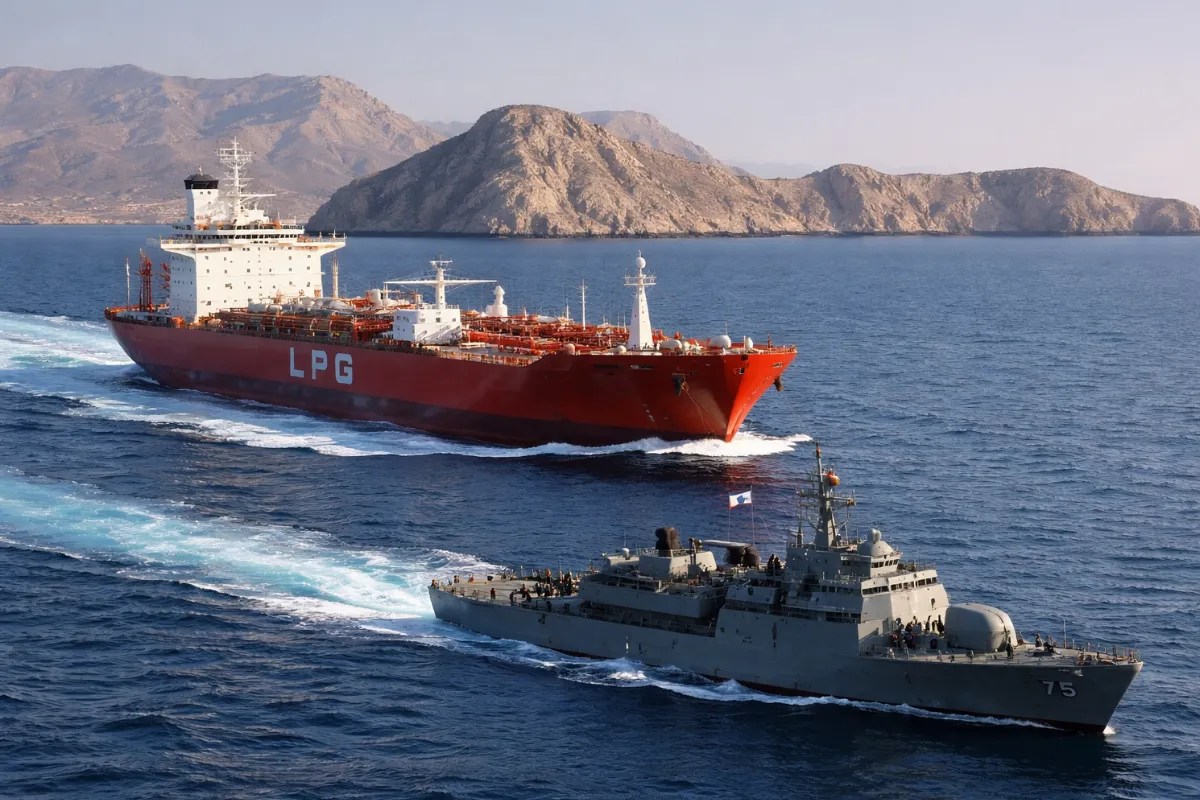
The world economy currently hangs by a thread roughly twenty-one miles wide. While headlines often focus on the immediate spikes in Brent crude prices whenever a tanker is harassed in the Persian Gulf, the structural reality is far more grim. The Strait of Hormuz is not just a shipping lane; it is the jugular vein of the global energy market. Approximately one-fifth of the world’s total petroleum consumption passes through this narrow stretch of water daily. If that flow stops, the modern industrial world does not just slow down—it fractures.
The true crisis is not a temporary shortage. It is the systemic inability of the global infrastructure to bypass this specific geographic bottleneck. Unlike the Red Sea or the Suez Canal, which offer long and expensive alternatives around the Cape of Good Hope, the Strait of Hormuz has no equivalent pressure valve. Once a ship enters the Persian Gulf, there is only one way out. If you enjoyed this post, you might want to read: this related article.
The Mathematical Certainty of Economic Contagion
To understand the stakes, look at the sheer volume of trade. We are talking about 20 to 21 million barrels of oil per day. When supply chains are as tightly optimized as they are today, even a 5% disruption in global supply can lead to a 50% increase in price. This is not linear math. It is exponential chaos.
The immediate impact hits the Asian markets first. Japan, South Korea, and India rely on the Gulf for the vast majority of their energy needs. If the Strait closes, these nations begin outbidding European and American buyers for any available cargo on the open sea. This creates a vacuum effect. Suddenly, a localized conflict in the Middle East dictates the price of a gallon of milk in a Midwestern grocery store because the transport costs for every single consumer good are tied to the global price of diesel. For another look on this story, see the latest coverage from Reuters Business.
The Pipeline Myth and the Failure of Redundancy
Governments often point to pipelines as the solution to the Hormuz problem. Saudi Arabia has the East-West Pipeline, and the United Arab Emirates operates the ADCOP line to Fujairah. On paper, these should mitigate the risk. In reality, they are a drop in the bucket.
The combined capacity of all functioning bypass pipelines in the region is less than 7 million barrels per day. That leaves over 13 million barrels stranded. Furthermore, these pipelines are fixed infrastructure. They are static targets. In a hot conflict, a pipeline is significantly easier to disable with a single drone strike than a fleet of dispersed tankers. We have seen this play out in the Abqaiq–Khurais attack, where a coordinated strike temporarily knocked out half of Saudi Arabia's production. Relying on pipelines to "solve" the Hormuz crisis is a dangerous exercise in wishful thinking.
Insurance Premiums as a Silent Weapon
Long before a single shot is fired, the financial markets begin the strangulation. Marine insurance is the invisible force that keeps global trade moving. Most tankers are covered by Protection and Indemnity (P&I) clubs. When a region is declared a "listed area" by the Joint War Committee in London, insurance premiums don't just rise—they skyrocket.
In previous periods of tension, we have seen "war risk" surcharges add hundreds of thousands of dollars to a single voyage. For many smaller shipowners, the risk becomes unpalatable. They pull their vessels from the route. This reduces the available "tonnage" or shipping capacity, driving freight rates into the stratosphere. Even if the Strait remains physically open, the cost of moving the oil can become so high that it triggers a global recession. The market prices in the fear long before the physical reality catches up.
The Asymmetric Advantage of Coastal Defense
The geography of the Strait favors the disruptor, not the protector. The shipping lanes are narrow, divided into two-mile-wide channels for inbound and outbound traffic, separated by a two-mile buffer zone. This makes tankers sitting ducks.
Modern naval warfare has shifted toward asymmetry. You do not need a billion-dollar destroyer to stop a tanker. You need a swarm of fast-attack boats, sea mines, and shore-based anti-ship missiles. This is the nightmare scenario for the U.S. Fifth Fleet. While they possess superior firepower, protecting a slow-moving, 300,000-ton steel box filled with flammable liquid in a confined space is a tactical impossibility. The aggressor only has to succeed once to cause an environmental and economic catastrophe; the protector has to be perfect every single time.
Liquefied Natural Gas and the Forgotten Crisis
While oil gets the spotlight, the world’s reliance on Liquefied Natural Gas (LNG) through Hormuz is perhaps more critical for the transition to "green" energy. Qatar is one of the world's largest exporters of LNG. Most of its output travels through the Strait.
Europe, having largely uncoupled from Russian pipeline gas, is now hyper-dependent on global LNG shipments. A closure of Hormuz doesn't just mean more expensive gas for cars; it means the lights go out in Berlin and London. There is no strategic reserve for LNG that compares to the Strategic Petroleum Reserve (SPR) for oil. Once the ships stop arriving, the clock starts ticking on the power grid.
The Geopolitical Chessboard and the Price of Neutrality
For decades, the United States acted as the guarantor of the Strait. That dynamic is shifting. As the U.S. became a net exporter of oil thanks to the shale boom, the political appetite for policing the Persian Gulf waned. However, the irony is that while the U.S. may not need the physical oil from the Gulf, it remains tethered to the global price.
China, now the world's largest importer of crude, has a much larger stake in keeping the Strait open. Yet, Beijing has shown little interest in taking over the security burden. They prefer to use their "neutrality" to negotiate discounted rates with sanctioned producers. This creates a power vacuum where non-state actors and regional powers feel emboldened to test the limits of international law. The old rules of "freedom of navigation" are being replaced by a transactional model of "protection for compliance."
The Strategic Petroleum Reserve is a Band-Aid
In the event of a total blockage, nations will look to their strategic reserves. The U.S. SPR and the IEA-mandated stocks can provide a cushion, but they are designed for short-term supply shocks, not a prolonged maritime blockade.
Withdrawing oil from the SPR is a complex process. It takes time to hit the refineries, and most of those refineries are configured for specific grades of crude. If the heavy, sour crude from the Gulf disappears, the light, sweet crude from American shale cannot simply be swapped in without significant efficiency losses. We are looking at a mismatch of chemistry and geography that the general public rarely understands.
Moving Toward a Hard Reality
The world has spent forty years pretending that the Strait of Hormuz is a manageable risk. It is not. It is a fundamental flaw in the design of global civilization. Every effort to diversify energy sources or find alternative routes has been dwarfed by the sheer increase in global energy demand.
True energy security would require a massive over-investment in redundant infrastructure that no private corporation is willing to fund and no government has the political will to mandate. Until then, we are all participants in a high-stakes gamble. The price of energy is not set by supply and demand in a free market; it is set by the stability of a single, narrow waterway controlled by some of the most volatile political regimes on earth.
Prepare for a future where energy is not a commodity, but a tool of siege warfare. The next time a tanker is seized, do not look at the price of oil. Look at the insurance rates and the shipping schedules. That is where the real war is won and lost.