The containment of an Ebola virus disease outbreak fails not from a lack of international concern, but from a fundamental misalignment between epidemiological velocity and supply chain response times. When a senior health official warns of "massive challenges" during an outbreak, they are observing the real-time friction between an exponential viral transmission curve and a linear, bureaucratic mitigation strategy.
To systematically dismantle an outbreak, the response cannot treat the situation as a generalized humanitarian crisis. It must be analyzed through a strict operational framework defined by three interlocking variables: transmission vectors, resource allocation mechanics, and community compliance elasticity.
The Transmission Function and Contact Tracing Saturation
The basic reproduction number ($R_0$) of Ebola typically ranges between 1.5 and 2.5 in under-resourced environments. This means each infected individual, on average, transmits the virus to approximately two other people. Containing the outbreak requires forcing the effective reproduction number ($R_t$) below 1.0.
The operational bottleneck to achieving $R_t < 1$ is the contact tracing saturation point. The mathematical reality of contact tracing requires a geometric expansion of personnel:
- Index Case Identification: A single confirmed case yields an immediate pool of 20 to 50 first-tier contacts (family, healthcare workers, burial participants).
- Secondary Monitoring: Each first-tier contact must be monitored daily for 21 days—the maximum incubation period of the virus.
- Network Expansion: If a contact develops symptoms before isolation, their own network must be mapped immediately, multiplying the required tracer workforce exponentially.
When an outbreak occurs in a densely populated urban center or a highly mobile border region, the tracing apparatus hits a resource ceiling. If the number of active cases exceeds the tracking capacity of the deployed epidemiological teams, the data goes dark. At this juncture, containment efforts shift from proactive ring-fencing to reactive mitigation, which structurally guarantees a prolonged outbreak timeline.
The breakdown in tracking is accelerated by the clinical presentation of the virus. Early symptoms—fever, profound fatigue, muscle pain, and headache—are indistinguishable from malaria, typhoid fever, or fulminant influenza. In a region where malaria is endemic, the false-positive rate for initial clinical presentations overwhelms isolation units. True Ebola cases are frequently co-mingled with non-Ebola febrile patients, driving nosocomial (hospital-acquired) transmission.
The Logistical Friction of Cold Chain Distribution
Deploying modern counter-measures, specifically recombinant vesicular stomatitis virus–Zaire Ebola virus (rVSV-ZEBOV) vaccines, introduces an acute logistical constraint: ultra-cold chain compliance.
The rVSV-ZEBOV vaccine requires storage temperatures between $-80^\circ\text{C}$ and $-60^\circ\text{C}$. In rural infrastructure lacking reliable electrical grids, the cold chain relies on specialized passive cooling devices, such as Arktek barrels, which utilize phase-change materials to maintain internal temperatures for up to several weeks without power.
This creates a distinct logistical cost function governed by geography and transport infrastructure:
Logistical Friction = (Distance from Central Depot / Transport Infrastructure Quality) x (Ambient Temperature / Power Reliability)
The operational constraints of this distribution model dictate strict field limitations:
- Hub-and-Spoke Limitations: Vaccines must be stored at a central urban hub with a functional power grid and backup generators. They are then moved to peripheral stabilization points using mobile ultra-low temperature freezers, and finally transported to the vaccination site via motorbikes or foot path teams using passive cooling containers.
- The Perishability Clock: Once a vaccine vial is thawed to $2^\circ\text{C}$ to $8^\circ\text{C}$ for field deployment, it has a strict shelf-life of approximately two weeks. If a target population cannot be reached due to washed-out roads, security threats, or geographic isolation, the biological assets expire, degrading the total allocation efficiency of the response.
- Dose Optimization Trade-offs: Ring vaccination strategies target the concentric circles of contacts around an infected individual. If a team travels six hours into a remote zone to vaccinate a ring of 30 people, but the vaccine vial contains 10 doses per vial and must be used within hours of puncture, the team faces a choice between wasting scarce doses or remaining in a high-risk zone to locate additional eligible recipients.
Community Compliance Elasticity and Communication Failures
The efficacy of epidemiological models relies heavily on human behavior. Community compliance elasticity measures how readily a population alters deeply ingrained cultural and economic behaviors in response to health directives.
When institutional directives conflict with local survival strategies, compliance drops sharply. This resistance is rarely irrational; it is a calculated response to perceived risk.
The Economics of Quarantines
For an individual living in an informal or subsistence economy, a 21-day quarantine equals a 100% reduction in income and caloric access for their household. If the state or international agencies do not provide immediate, reliable food and water subsidies directly to the isolated doorstep, the economic cost of compliance exceeds the perceived statistical risk of viral infection. Individuals will actively evade contact tracers to maintain daily labor routines.
Cultural Rites versus Bio-Hazard Protocols
Traditional burial practices frequently involve washing, touching, and preparing the deceased. At the time of death, the viral load in an Ebola victim’s bodily fluids reaches its peak, rendering the corpse extraordinarily infectious.
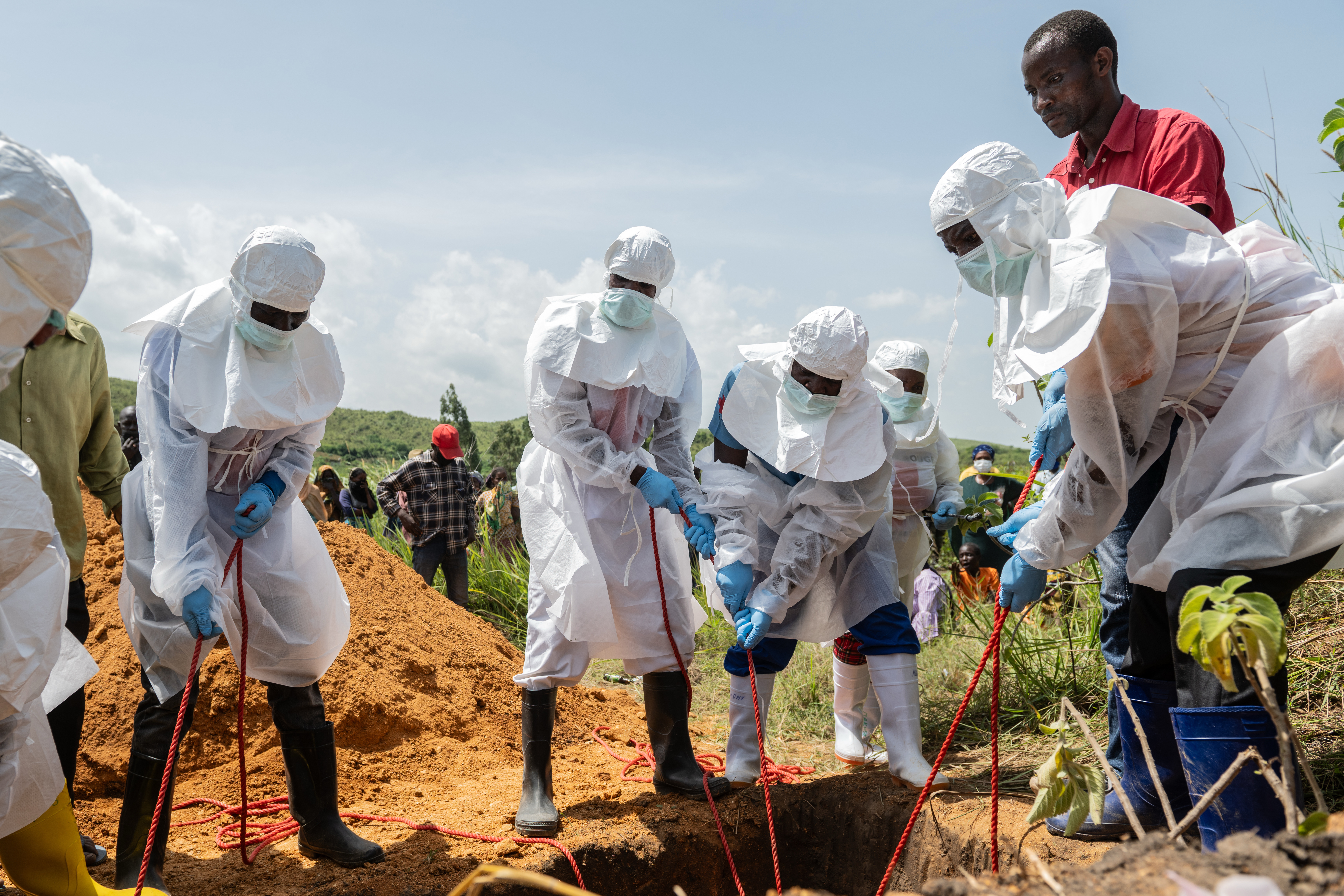
Imposing sterile, highly clinical "Safe and Dignified Burials" (SDB) executed by teams in white personal protective equipment (PPE) strips the community of agency and grieving rituals. When institutional teams forcibly remove bodies without explaining the biological mechanisms or respecting local traditions, communities respond by conducting clandestine night burials. This drives unmonitored super-spreader events that completely bypass the contact tracing network.
Institutional Friction points:
[Top-Down Commands] -> [Incursion of White PPE Teams] -> [Clandestine Burials] -> [Surge in Unmapped Cases]
To counter this, a strategic pivot is required: the transformation of SDB protocols from an external enforcement mechanism into a collaborative process. Training local religious and community leaders to oversee the spiritual aspects of the burial from a safe distance, while trained local youth execute the bio-hazard containment protocols, bridges the compliance gap.
Clinical Infrastructure Bottlenecks and Nosocomial Feedback Loops
Ebola treatment centers (ETCs) are high-risk operational environments where a single breach in protocol can incapacitate the local medical workforce. The primary operational challenge within an ETC is the maintaining of a strict red-zone/green-zone boundary.
The physical exertion of working in full PPE in tropical climates limits a clinician's effective shift to 40-60 minutes before cognitive and physical fatigue introduces catastrophic error margins. Stripping down (doffing) PPE is the highest-risk activity; it requires a trained observer to monitor every movement to ensure contaminated material does not brush against exposed skin.
When an influx of patients exceeds the clinician-to-patient ratio, the following feedback loop occurs:
- Patient volume surges, reducing the time clinicians can allocate per bed.
- Clinician fatigue increases due to extended shifts in heat-trapping PPE.
- Protocol adherence degrades during the doffing phase, leading to health worker infections.
- Medical personnel go from being active intervention assets to intensive care liabilities or fatalities.
- The local healthcare infrastructure collapses as non-Ebola services (maternity, trauma, malaria care) shut down out of fear, causing a spike in all-cause mortality that dwarfs the direct Ebola death toll.
Resource Deployment Optimization: A Strategic Playbook
To transition an Ebola response from an ad-hoc emergency intervention to a predictable, systematic containment operation, international and local actors must execute a synchronized triage of resources.
Decouple Logistics from Clinical Personnel
Do not deploy highly trained epidemiologists or medical doctors to manage vehicle fleets, supply inventories, or cold-chain integrity. Establish a dedicated operational logistics command run by supply-chain experts whose sole KPI is the minimize time-to-site for essential materials. This frees clinical assets to maximize patient-facing hours within the red zone.
Shift to decentralized Rapid Isolation Units
Large, centralized ETCs require patients to travel long distances, which spreads the virus along transit corridors. Deploy modular, scalable isolation tents (such as the CUBE system) directly to peripheral health posts. This allows immediate isolation of suspected cases within their immediate geographic cluster, short-circuiting the transmission line before long-distance transport is required.
Pre-Position Compensation Funds for Quarantined Households
Treat quarantine compliance as an economic transaction. Simultaneously with the issuance of a 21-day monitoring order, distribute direct unconditional cash transfers or standardized caloric packs that exceed the household's average daily earning power. Removing the economic penalty of isolation is the single most effective lever to increase contact tracing accuracy and compliance.