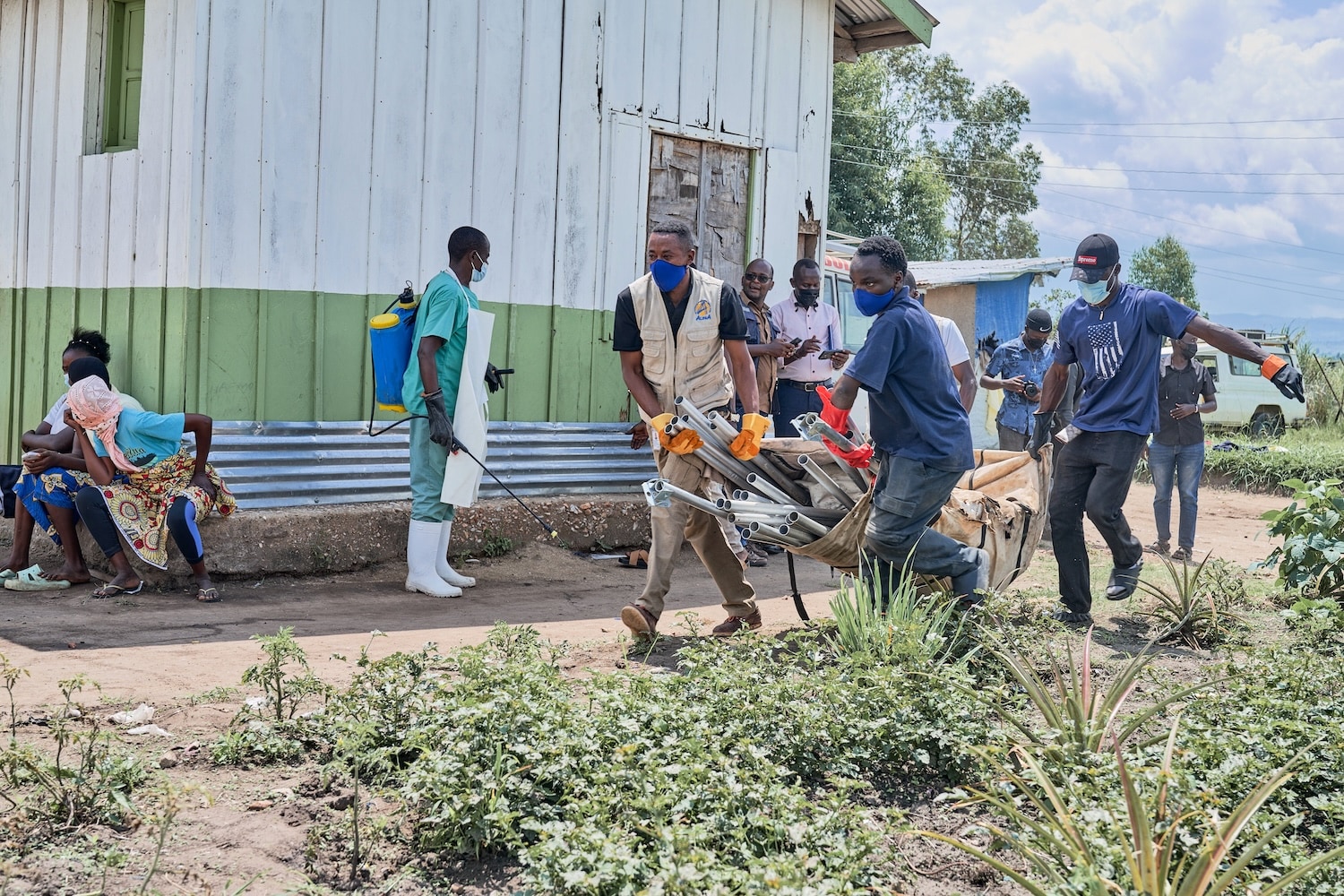
The rain in northeastern Democratic Republic of Congo does not fall; it heavy-drops, blindingly fast, turning the red volcanic soil into a thick, clinging clay. If you walk through the dense canopy of North Kivu, the air feels like wet wool. It is quiet. But underneath the canopy, a tally has been keeping itself in scratch marks on clinic walls and numbers typed into slow satellite phones.
One thousand.
It is just a digit. A comma followed by three zeros. To an actuary or a data scientist sitting in a climate-controlled office in Geneva, it is a milestone on a graph, a predictable upward curve in a protracted outbreak. But if you are standing in the mud outside a makeshift isolation ward in Beni, that number changes shape. It becomes a thousand distinct front doors. A thousand families who had to decide whether a sudden, blinding fever was a passing malaria bout or the beginning of the end of their world.
The official reports state that the current Ebola outbreak has crossed the threshold of 1,000 confirmed cases, carrying with it a confirmed death toll of 254 people. It sounds sterile. It sounds managed.
It is not.
To understand why a virus that we know how to identify—and technically know how to treat—can still swallow a thousand people in the modern era, you have to look past the microscopes. You have to look at the invisible lines drawn across the jungle floor.
Consider a hypothetical woman named Masika. She is not a statistic yet. She lives on the outskirts of Butembo, sells cassava root at the market, and supports three children. One evening, her brother arrives from a nearby village. He is hot to the touch. He is vomiting. In a textbook world, Masika calls the hotlines. A team arrives in white Tyvek suits, looking like plastic ghosts. They isolate him. They spray the house with chlorine.
But Masika does not live in a textbook. She lives in a region scarred by twenty-five years of armed conflict. The people in the white suits speak with accents from the capital, hundreds of miles away. The local radio whispers that the treatment centers are places where organs are stolen, or that the virus is a political invention to delay the upcoming elections.
When your survival has depended on distrusting outsiders for a generation, compliance is not a medical decision. It is a terrifying gamble.
So, Masika washes her brother's forehead with a damp cloth. She holds his hand. She wipes away the fluid. By doing what every human culture defines as sacred—caring for her dying kin—she seals her own fate. The virus relies on our best instincts. It uses love as its primary vector.
The biological reality of Ebola is terrifying, but it is also remarkably simple. The virus is a fragile strand of RNA wrapped in a protein coat. Outside the human body, it dies easily; a splash of household bleach destroys it instantly. It cannot travel through the air. It does not fly on the wings of mosquitoes. To catch it, you must intimately touch the fluids of someone who is actively succumbing to it.
The mystery, then, is not how the virus works, but why it wins.
It wins because a clinic is never just a clinic. In North Kivu, health workers face more than a pathogen; they face machetes and gunfire. Treatment centers have been set on fire by unidentified militias. Health workers have been assassinated in their beds. When panic collides with a deep-seated history of exploitation, the medical response becomes a militarized zone. You cannot easily vaccinate a village when the vaccinators require armed escorts just to walk down the main road.
The response teams speak of "contact tracing" as if it were a digital network, a clean web of data points. In reality, it is a desperate footrace through the bush. A single person who flees a quarantine zone because they are terrified can seed a new cluster thirty miles away, across a river, down a path that doesn't appear on any map. The tally climbs from 950 to 980, then to 999, and then the line breaks.
We often think of medical progress as a linear march forward. We have experimental vaccines now—the rVSV-ZEBOV shot has shown incredible efficacy in controlled trials. We have therapeutic molecules that can block the virus from replicating if given early enough. The science is magnificent. It is brilliant.
But science is useless if it cannot cross the threshold of the home.
The real tragedy of the thousandth case is the realization that human trust is a finite resource, and once it is depleted, no amount of international funding can buy it back. The response fails when it treats the outbreak as an engineering problem to be solved with logistics, rather than a human crisis rooted in fear and historical trauma.
The international community watches the numbers tick upward with a familiar, detached anxiety. There will be meetings. There will be press releases detailing the allocation of millions of dollars. But on the ground, the money thins out until it is just a lone nurse standing in a clinic with a broken generator, trying to explain to a weeping father why he cannot hold his daughter's body before she is buried in a plastic bag.
The rain eventually stops in Beni, leaving the air heavy and thick with the scent of wet earth and woodsmoke. The sunset turns the sky an bruised, violent purple. Inside the treatment centers, the monitors hum against the dark. Outside, the jungle goes on forever, hiding its dead, waiting for the next door to open.