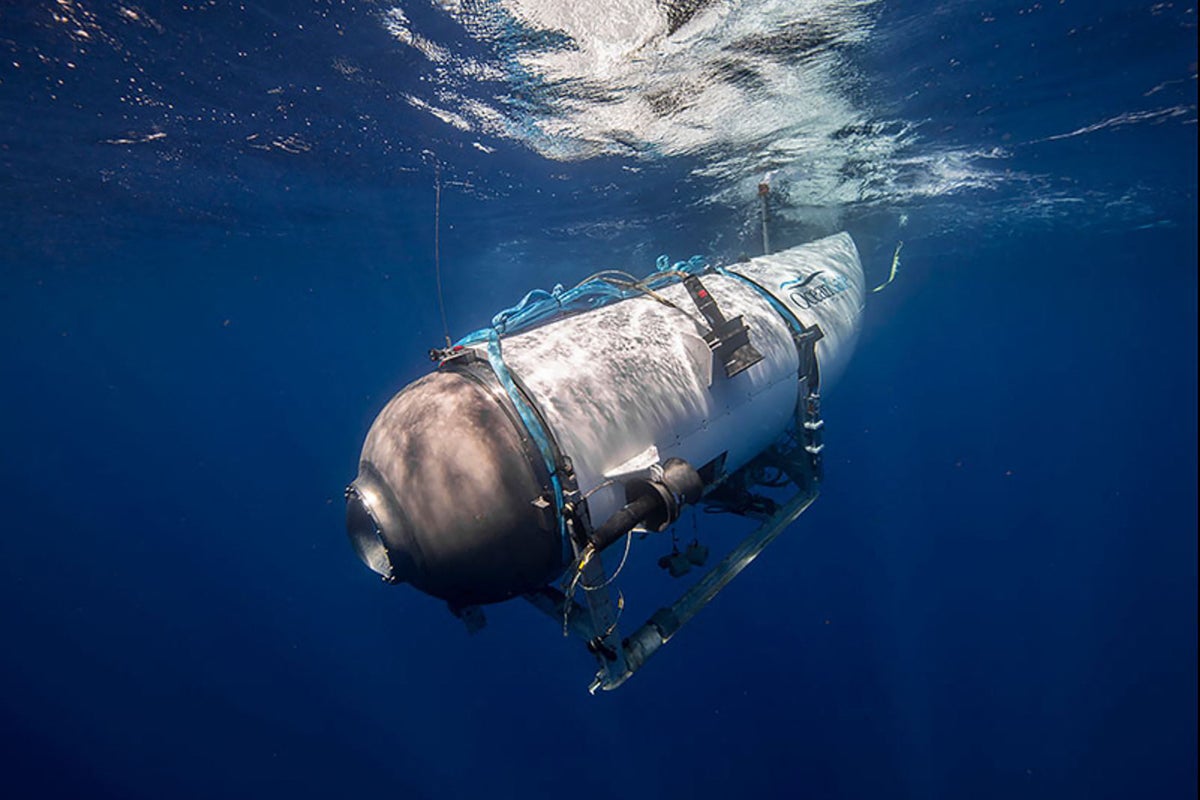
The media post-mortem on the Titan submersible disaster has settled into a comfortable, lazy consensus. The narrative is neat: a cowboy CEO ignored certified engineering, bypassed standard maritime regulations, and paid the ultimate price for his hubris. Every major news outlet points to the damning final reports as proof that the existing regulatory apparatus is a sacred shield protecting humanity from catastrophic failure.
They are wrong. They are misdiagnosing the disease.
The consensus blames a lack of oversight. But the hard truth is that the traditional maritime certification matrix was never built to handle radical material innovation. Stockton Rush’s real sin wasn't just bypassing the rules; it was believing that the established aerospace-grade data on carbon fiber could be effortlessly mapped onto deep-sea compression environments without an entirely new framework of continuous acoustic monitoring.
Blaming "a lack of regulation" misses the point. Had OceanGate spent five years and twenty million dollars chasing a traditional classification society stamp from Lloyd's Register or the American Bureau of Shipping (ABS), those legacy institutions would have forced them to build a heavy, uninspired steel or titanium sphere. Innovation would have been regulated out of existence before the hull ever touched the water.
The tragedy wasn’t that the rules were broken. The tragedy is that our current engineering paradigm knows how to certify the past, but is utterly clueless about how to validate the future.
The Carbon Fiber Fallacy Where Both Sides Got the Physics Wrong
Critics love to scream about carbon fiber being an inherently flawed material for deep-sea submersibles. They cite the material's asymmetric strength properties, noting that while carbon fiber is brilliant under tension (pulling apart), it behaves unpredictably under extreme compression (crushing forces).
This is basic undergraduate engineering. It is also an oversimplification.
The issue isn’t that carbon fiber cannot withstand 4,000 meters of hydrostatic pressure. It can. The real failure mechanism lies in the interlaminar shear stress and the micro-buckling of individual carbon filaments over repeated cycles of loading and unloading.
The Micro-Fatigue Trajectory
- The First Descent: The composite matrix absorbs the immense compressive force, performing exactly as modeled.
- The Decompression Phase: As the vessel ascends, microscopic voids form between the resin and the carbon fibers due to tiny amounts of residual stress.
- The Cumulative Degradation: With each subsequent dive, these invisible delaminations multiply. The material does not show external deformities; it degrades internally, silently, until it hits a tipping point.
Traditional non-destructive testing (NDT) methods, like standard ultrasound, struggle to map these microscopic delamination networks across a thick-walled composite cylinder. The industry standard protocols are built for isotropic materials—metals like titanium and steel that fail predictably, stretch before they break, and exhibit measurable fatigue curves.
OceanGate relied on an in-house acoustic monitoring system to detect the sound of breaking fibers in real-time. This wasn't inherently bad science; it was an attempt to solve the NDT problem. However, treating a real-time warning system as a substitute for an established, predictive lifecycle model is a fatal operational error. You don't use a smoke detector as a substitute for fireproof walls.
The Bureaucracy Illusion Why Certification Is a False Security Blanket
Let's dismantle the corporate obsession with third-party certification.
In aerospace, defense, and maritime engineering, getting a design "classed" or certified by an official body is frequently treated as an absolute guarantee of safety. It isn’t. Certification is a historical record of what worked yesterday. It is a lagging indicator.
| Material / Method | Regulatory Status | Failure Mode | Predictability |
|---|---|---|---|
| Titanium / Steel Hulls | Fully Certified / Standardized | Yielding / Measurable Fatigue | High (Linear) |
| Carbon Fiber Composites | Unclassified for Deep Submergence | Interlaminar Shear / Delamination | Low (Non-Linear) |
| Real-Time Acoustic Testing | Experimental / Supplementary | Signal Saturation / Late Warning | Unpredictable |
When a company develops something genuinely novel, classing societies do not have an existing checklist to grade it against. What happens instead? The regulatory body charges millions of dollars to assemble a committee, look at the novel design through the lens of old rules, and eventually demand so many conservative modifications that the original innovation is diluted into a standard, inefficient product.
I have watched hardware startups burn through their entire Series A funding rounds trying to satisfy regulatory checklists written in the 1980s. The process doesn’t make the technology safer; it just ensures that only massive defense contractors with infinite compliance budgets can afford to build anything.
If you rely solely on external certification to validate your engineering, you have already lost control of your safety culture. True safety requires an internal, obsessive understanding of your specific failure modes—not a rubber stamp from a bureaucrat who hasn't looked at a calculus textbook in twenty years.
Dismantling the People Also Asked Propaganda
The public post-mortems are filled with flawed premises. Let's correct the record on the questions everyone keeps asking.
"Why didn't they just use a titanium hull like everyone else?"
Because using titanium solves yesterday's problem while ignoring the economics of tomorrow's exploration. Titanium is heavy, exceptionally expensive to machine at scale, and limits the payload capacity and interior volume of the vehicle. If deep-sea exploration is ever going to scale beyond government-funded military research and ultra-wealthy vanity projects, the weight-to-volume ratio must be solved. Composites are the logical path forward. The failure of OceanGate's specific execution does not change the laws of mass optimization.
"Should the government ban experimental submersibles in international waters?"
A ban is a blunt instrument used by nations that fear risk more than they value progress. International waters are the last frontier of regulatory arbitrage, and they must remain that way. If you criminalize high-risk hardware development, you don't stop the development; you merely push it into underground, unmonitored gray markets. The maritime industry needs open-source data sharing on failure mechanics, not an international police force tracking experimental hulls.
The Hard Lesson for Hardware Founders
If you are building complex, high-consequence physical systems, the takeaway from the Titan disaster cannot be "wait for permission." If you wait for permission, you will never launch.
Instead, the lesson is about the brutal honesty required in telemetry and testing.
- Never substitute real-time monitoring for destructive lifecycle testing. You must cycle your prototypes to absolute destruction under real-world conditions before you put a human life inside them. If your hull is rated for 4,000 meters, crush three of them to pieces at 8,000 meters first. Find the absolute edge.
- Isolate your life-critical systems. The integration of consumer-grade electronics (like the infamous logistics controllers) isn't inherently flawed if the primary flight control and life support systems are completely air-gapped, redundant, and built to industrial automation standards. The mistake was a lack of systemic architecture separation.
- Build an internal culture of dissent. The moment you fire a chief pilot or a senior engineer for raising technical concerns—as OceanGate notoriously did—you have effectively signed your company's death warrant. The engineering data doesn't care about your quarterly milestones.
The Price of Moving Fast
Every major leap in human transit infrastructure—from early steam locomotives to the initial commercial aviation fleets—was built on a foundation of catastrophic failures and twisted metal. The public has been conditioned by decades of software updates to believe that development can be clean, virtual, and risk-free.
It cannot. When you defy extreme physical environments, the universe eventually extracts a tax in blood and steel.
The current hand-wringing over the Titan report seeks to create a world where no one is allowed to fail, no one is allowed to take extreme risks, and everything is governed by a committee of risk-averse legacy operators. That world is stagnant.
The design failed. The execution was flawed. The company collapsed. That is the natural, brutal cycle of extreme engineering. But do not let the bureaucrats convince you that the rules are the solution. The rules are just the epitaph of the last guy's mistakes. Stop looking for a rubber stamp to save you, build better telemetry, crush your hardware in testing before the ocean does it for you, and keep building.