The rain in northeastern Democratic Republic of Congo does not fall; it heavy-pours, blanketing the dense canopy of North Kivu in a thick, suffocating humidity. In the small, bustling market towns that dot this region, life usually moves to the rhythm of motorcycle taxis and the bartering of cassava. But thirty days ago, a quiet shift occurred. A shadow slipped into the clinics and homesteads, invisible but devastatingly precise.
Statistics tell us that within four weeks, more than two hundred people have died. They tell us the mortality rate sits stubbornly at twenty-three percent.
But numbers are cold comfort when you are staring at a plastic-zippered body bag. To understand what is happening here, one must look past the spreadsheet. Look instead at the red dirt roads where custom dictates that you comfort the grieving with a hand on the shoulder, and where that very touch has suddenly become a gamble with death.
The crisis did not announce itself with a trumpet blast. It began with a fever.
The Weight of an Unseen Enemy
In the early days of an outbreak, Ebola looks like everything else. It mimics malaria. It masquerades as typhoid. A mother looks at her sweating child and thinks of the common ailments that have always drifted through the equatorial heat. She does what any parent would do: she wipes the child’s brow with a cool cloth. She holds them close.
This is the cruelest trick of the virus. It weaponizes human empathy.
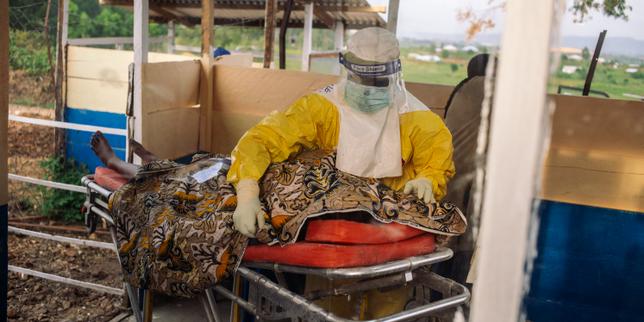
Consider a hypothetical healthcare worker named Jean, a composite of the dedicated local nurses currently standing on the front lines of this crisis. Jean works in a rural clinic with cracked linoleum floors and a single solar-powered refrigerator. When the first patients arrived a month ago, complaining of intense fatigue and muscle aches, he did not wear a heavy, pressurized rubber suit. He wore standard latex gloves, if they were available, and offered paracetamol.
Within days, the virus began its rapid replication inside its hosts, shutting down the body's ability to clot blood.
When the realization finally struck that Ebola had returned, the panic was not loud. It was a sudden, collective holding of breath. The local market, usually a riot of color and shouting, grew sparse. People stopped shaking hands. In a culture where physical greeting is the cornerstone of community trust, the sudden enforcement of distance felt like a tearing of the social fabric.
The data released at the one-month mark confirms the grim trajectory, noting that the speed of transmission has outpaced early containment efforts. But a spreadsheet cannot capture the smell of chlorine that now hangs over the treatment centers, or the eerie silence of a quarantine zone where family members can only peer through double-layered mesh screens to see if their loved ones are still breathing.
Deciphering the Math of Survival
Medical textbooks often focus heavily on the highest mortality rates of Ebola, recalling past outbreaks where nine out of ten patients perished. A twenty-three percent mortality rate might appear, to an outside observer reading a headline in a distant capital, almost reassuring.
It is a lethal misunderstanding.
A twenty-three percent fatality rate means nearly one in four people who contract the virus will die. In a crowded region plagued by conflict and deep-seated displacement, that percentage represents an absolute catastrophe. It means the virus is virulent enough to kill on a massive scale, yet stable enough to keep its hosts alive long enough to move, travel, and inadvertently infect dozens of others before succumbing or recovering.
The mathematics of an epidemic are driven by human behavior. If a virus kills too quickly, it burns out, running out of vectors to exploit. A rate of twenty-three percent is a terrifying sweet spot for transmission. It creates a lingering illusion of safety that encourages people to delay seeking professional medical care, thinking their symptoms are merely a passing bug. By the time they realize the truth, the virus has already traveled down the trail, slipped into the next village, and found a home in a new household.
Moreover, the response infrastructure is fighting a war on two fronts: the biological pathogen and a profound, historical skepticism. For decades, the people of North Kivu have navigated geopolitical instability, shifting rebel factions, and promises of aid that rarely materialized. When foreign vehicles painted with international logos suddenly arrive, demanding that traditional burial practices be abandoned and that the sick be isolated in plastic tents, the reaction is not always compliance. Sometimes, it is flight.
When a family hides a sick relative out of love, out of a desire to protect them from dying alone in a sterile isolation ward, the virus wins. The infection chain grows another link.
The Thin Line in the Mud
Controlling an outbreak requires an almost military precision, yet the tools available are devastatingly analog. Contact tracing involves walking. Miles of it. Health workers must retrace every single step a patient took while infectious, tracking down every person they spoke to, shared a meal with, or brushed past in a crowded minibus.
The work is grueling, dangerous, and deeply unglamorous. It happens on the backs of motorbikes navigating washed-out roads, where the threat of armed ambush is as real as the microscopic threat in the air.
There is a profound vulnerability in admitting that despite decades of scientific advancement, despite the development of newer vaccines and experimental treatments, the primary weapon against Ebola remains a simple bar of soap, a bucket of chlorinated water, and the fragile trust of a frightened community. The technology matters, but only if the person holding the syringe is trusted by the person baring their arm.
A month into this latest battle, the collective exhaustion is palpable. Local doctors and nurses have not slept more than a few hours a night. They watch their colleagues fall ill. They know the statistics better than anyone, because those numbers are not abstract data points; they are the names of friends, neighbors, and fellow healers written in permanent marker on whiteboards inside the command centers.
The rain continues to hit the corrugated tin roofs of the treatment units, masking the sound of the clinicians inside as they move between beds. The initial month has drawn a stark line in the mud of the Congo. Over two hundred gone. Many more fighting for breath. The world looks at the percentage and calculates the risk of global spread, but here, the calculation is much simpler, reduced to a daily, agonizing question asked by hundreds of families waiting outside the gates.
Will the zipper on the tent open to release a survivor, or will it stay closed?
A small boy sits on a wooden bench fifty yards from the red-zone barrier, his eyes fixed on the entrance. He is wearing a faded yellow shirt, far too large for him, and he does not move despite the damp chill rising from the ground. He is waiting for his older sister, who went inside three days ago. He does not know about the twenty-three percent. He only knows that his house is completely quiet, and that he is entirely alone.