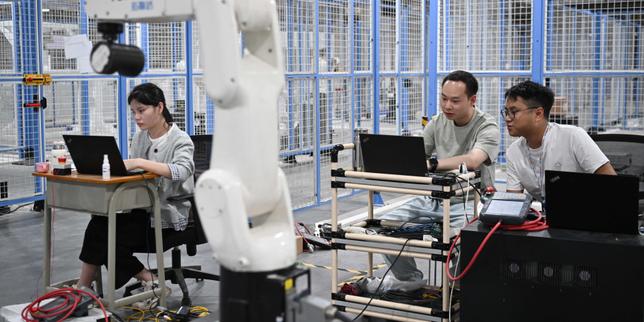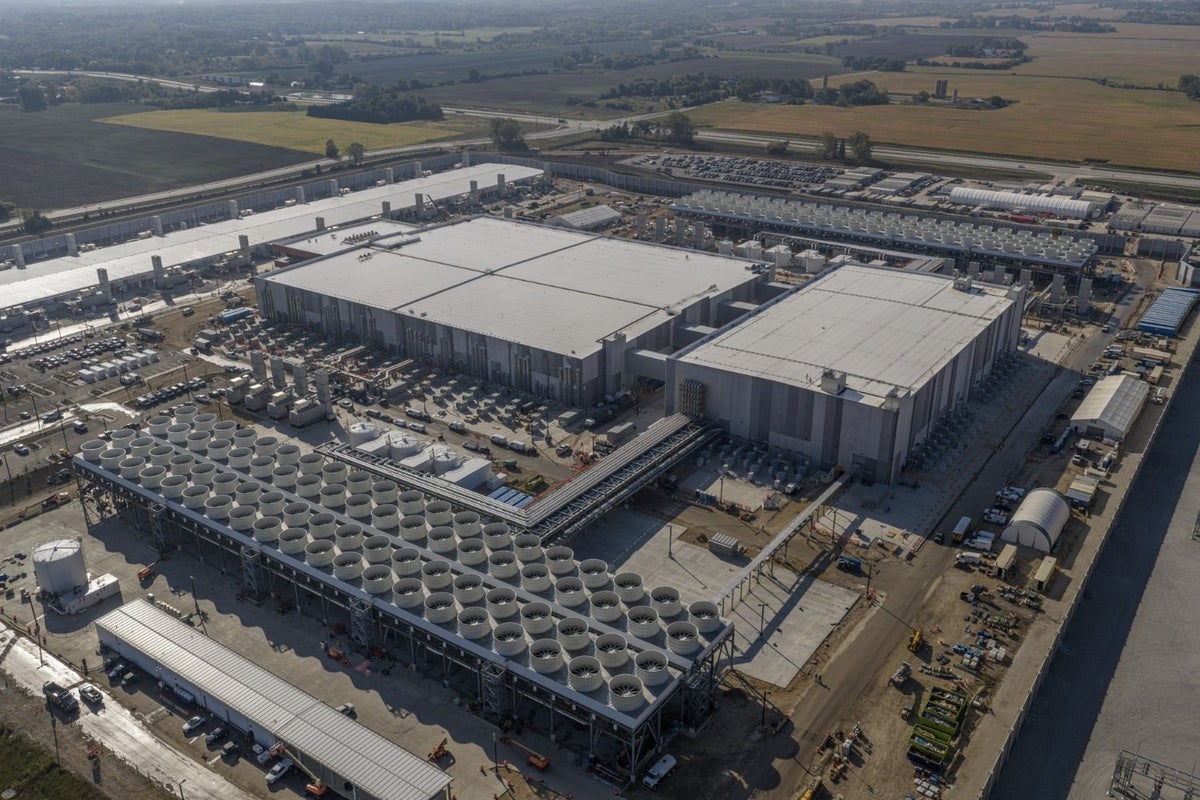
For decades, Dongguan was a city defined by the clatter of assembly lines and the smell of cheap plastics. If you owned a pair of sneakers, a plastic toy, or a mid-range smartphone in the early 2000s, chances are it passed through this sprawling metropolis in southern China. It was the world’s workshop. A place where human labor was cheap, hours were long, and the margin for error was measured in millimeters.
But a strange transformation has taken place beneath the surface of this industrial giant. If you liked this article, you should check out: this related article.
If you drive out to the Songshan Lake district, away from the concrete blocks of the old factory quarters, the landscape shifts into manicured greenery. Beneath this quiet parkland lies a circular concrete tunnel, deep underground, where particles are whipped to nearly the speed of light.
This is the China Spallation Neutron Source. At its heart sits a rapid-cycling synchrotron, a massive machine designed to solve a problem that traditional manufacturing simply cannot touch. For another angle on this event, refer to the recent coverage from The Next Web.
To understand why this matters, you have to look at the invisible limits of modern technology.
Consider a hypothetical engineer named Chen. For years, Chen’s job at a prominent local electronics firm was simple: assemble components designed elsewhere. But as the global market shifted, his company decided to build something of their own—an advanced, solid-state battery meant to power the next generation of electric vehicles.
On paper, the chemistry worked. In the laboratory, the prototypes looked flawless. But when placed under rapid charging cycles, the batteries failed. Mysteriously. Repeatedly.
The microscopic layers of lithium inside the battery were degrading, but standard microscopes couldn't see why. Traditional X-rays bounce right off the heavy casing, or they fail to detect the light, nimble lithium atoms altogether. Chen was flying blind, guessing at chemical adjustments, losing millions of dollars with every failed batch.
This is the exact wall that modern manufacturing has hit. We are trying to build technologies that operate at the atomic scale, but our eyes are still macro.
That is where the underground ring in Dongguan comes in.
A synchrotron-driven spallation source does not use light to see; it uses subatomic violence. The synchrotron accelerates a beam of protons to staggering speeds, then smashes them into a heavy metal target, usually tungsten. The collision knocks neutrons loose from the tungsten atoms in a sudden, intense burst.
These neutrons are directed into specialized beamlines, pointing straight at material samples like Chen’s failing battery cells. Because neutrons pass easily through heavy metal casings but scatter wildly when they hit light elements like lithium, they act as the ultimate spy.
When Chen took his prototype to the facility, the resulting data did not just show a static image. It mapped the real-time movement of lithium ions during rapid charging. For the first time, he could see the microscopic structural bottlenecks causing the failure.
With that data, the team altered the chemical architecture, improving the cycle life of their solid-state cells by nearly 30 percent.
Dongguan's massive machine is shifting the city from a place that merely bends metal to a place that dictates the atomic structure of the future. The stakes are no longer about who can hire the most workers, but who can control the behavior of electrons and neutrons.
But the reach of this industrial microscope extends far beyond the battery packs of electric cars.
Consider what happens next when you scale this capability up to the aerospace sector. For years, manufacturing critical components for commercial aviation—like the massive titanium engine mounts required for wide-body jets—involved a terrifying amount of guesswork. A 3D-printed titanium alloy part can look pristine on the outside while harboring a microscopic, fatal structural flaw within its core.
By utilizing the multi-physics instruments attached to the Dongguan synchrotron network, aerospace engineers can now peer deep inside the dense crystalline structures of these alloys. They can see stress fractures before they even form, ensuring that the components holding commercial aircraft engines together are structurally sound at an atomic level.
The transition from a low-cost assembly hub to a high-tech superpower is a bumpy, expensive road. The facility cost billions of yuan to construct and requires a small army of specialized physicists just to keep the beam stable. For a long time, local traditional factory owners looked at the massive complex with skepticism. It seemed like an ivory tower project, detached from the gritty reality of supply chains and quarterly margins.
Yet, the intersection between pure science and raw commerce is proving to be tighter than anyone anticipated.
The underground loop is even fundamentally changing medicine. Recently, researchers at the facility leveraged the accelerator’s technology to venture into advanced cancer therapies. By utilizing the intense proton and neutron fluxes, scientists have successfully begun producing rare medical isotopes like Actinium-225. These isotopes act as targeted alpha-particle therapies—miniature, precise tools that seek out and destroy late-stage tumor cells with pinpoint accuracy, leaving surrounding healthy tissue untouched.
In early clinical trials for recurrent nasopharyngeal carcinoma, patients saw complete tumor remission after just a single targeted session.
The dry balance sheets of the old Dongguan factories are being replaced by a new kind of currency: atomic precision. The city that once clothed the world is now decoding the fundamental materials that will power, transport, and heal it.
The real power of the machine under Songshan Lake isn't just the physics. It is the realization that in the modern industrial race, the most valuable factory floor is the one you can only see through a beam of accelerated particles.