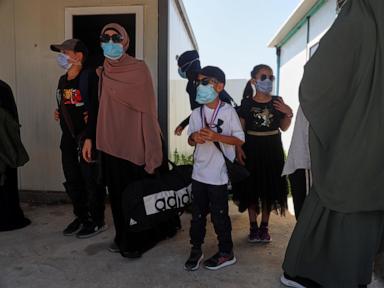
The plane touching down at Tullamarine this week does not carry tourists or business travelers. It carries a political crisis the Australian government has spent years trying to ignore. After seven years of legal limbo and diplomatic stalling, four Australian women and nine children have effectively forced their own repatriation from the Al Roj detention camp in northeast Syria. They did not arrive on a government-chartered jet, and they will not find a welcoming committee. Instead, they face a phalanx of federal agents and the very real prospect of a jail cell.
The arrival of this cohort—specifically the Abbas family from Melbourne and Janai Safar in Sydney—marks a tipping point in Australia’s long-running struggle with its "ISIS brides." For years, the official line from Canberra has been a calculated shrug: the government will not assist those who made "appalling decisions" to support a terrorist caliphate. But by securing their own travel documents and booking commercial flights from Damascus via Doha, these women have stripped away the government’s ability to use "logistical impossibility" as a shield.
The Myth of Governmental Assistance
Home Affairs Minister Tony Burke was quick to distance the state from the return. "The government is not assisting and will not assist these individuals," he declared, a statement designed to mollify a public wary of tax dollars spent on former associates of the Islamic State. But this hardline rhetoric masks a more complex reality. While the government did not charter the flight, it did provide the travel documents. Under international law, a country cannot legally block its own citizens from returning unless it invokes specific, high-threshold exclusion orders.
One such order was used in February to bar a single woman from the group, effectively stranding her while her peers moved toward freedom. For the remaining thirteen, the government had no choice but to let them come home—and then prepare to prosecute them.
The Australian Federal Police (AFP) have been building these briefs for years. This is not just about "traveling to a proscribed area." Commissioner Krissy Barrett has signaled that investigators are looking into much darker allegations, including potential crimes against humanity and involvement in the slave trade. The mission is clear: if the government couldn't keep them out, they will ensure they are locked in.
The Raqqa Trap and the Burden of Proof
The primary legal weapon in the AFP's arsenal is Section 119.2 of the Criminal Code, which makes it a crime to enter or remain in a "declared area"—specifically Raqqa province between 2014 and 2017. It is a strict liability offense, but it isn't a guaranteed conviction.
The case of Mariam Raad, who returned in 2022, serves as the blueprint. Raad was charged with entering a proscribed area but eventually received a conditional discharge. The challenge for the prosecution in the upcoming cases will be proving what these women did behind the high walls of the caliphate. Were they coerced wives, as many claim, or were they active participants in the machinery of a genocidal regime?
Key Legal Hurdles for the Prosecution
- Evidence Chain: Collecting admissible evidence from a war zone controlled by shifting militias and foreign powers is a forensic nightmare.
- The Coercion Defense: Many women claim they were misled by husbands or forced to follow them under duress.
- The Humanitarian Loophole: Providing aid is a legitimate defense under the declared area laws. The Abbas family, for instance, has long maintained that the patriarch, Mohammad Ahmad, was performing aid work before he was suspected of using a charity as an ISIS front.
The Stolen Childhoods of Al Roj
While the legal battle focuses on the adults, the nine children—some born in the squalor of detention camps—represent a different kind of challenge. These children have known nothing but razor wire, malnutrition, and the extremist ideologies that permeate the camps.
The government’s plan for them is "reintegration," a clinical term for a deeply fraught process. These children will undergo "countering violent extremism" (CVE) programs and intensive psychological support. Experts warn that treating these children as security threats rather than victims of their parents' choices is a recipe for the very radicalization the state seeks to prevent. Unlike their mothers, these children are not being arrested, but they are returning to a country that largely views their existence as a liability.
A Policy of Kicking the Can
The "hardline stance" touted by successive Australian governments has often looked more like a policy of avoidance. By refusing to repatriate the larger group of 34 Australians still in Syria, the government has allowed the situation to deteriorate. The recent shift in the Syrian conflict—where government forces seized territory from the Kurdish-led SDF—created the chaos that allowed this specific group to move toward Damascus.
The U.S. government has repeatedly urged its allies to take back their citizens, arguing that leaving them in camps is a long-term security risk. Australia’s reluctance has turned a manageable repatriation into a chaotic, self-directed return that leaves the AFP scrambling to secure evidence.
The reality is that "out of sight, out of mind" was never a permanent solution. The arrival of the Al Roj thirteen is just the beginning of a long, expensive, and emotionally charged legal saga. It forces the Australian public to confront a difficult question: What does the state owe to citizens who turned their backs on it? The answer, for now, is a court date and a heavy police presence.
The plane has landed, the doors are open, and the political insulation has finally worn through. The reckoning has arrived.