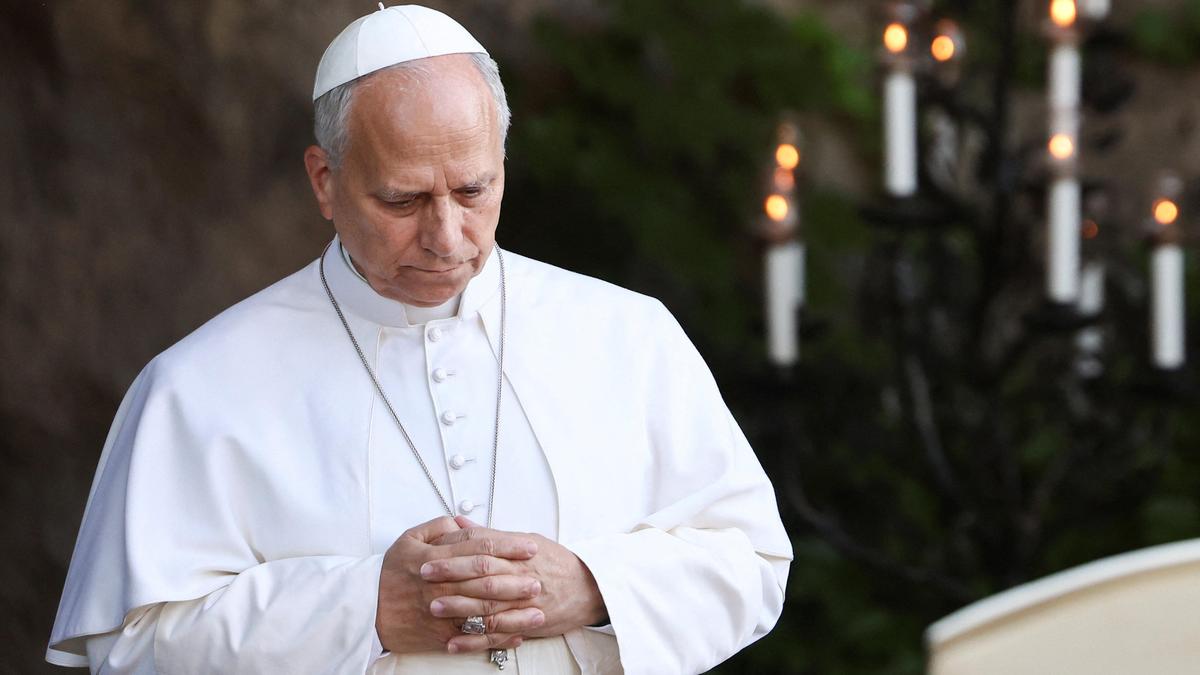
The world did not expect its most potent critique of technological feudalism to come from a 70-year-old man wearing Nike sneakers under his vestments. When Pope Leo XIV released his 42,300-word encyclical, Magnifica Humanitas, the internet responded with a wave of viral memes, declaration videos, and unlikely digital alliances. On Instagram and X, young atheists and lapsed Catholics celebrated the pontiff's sudden transformation into an anti-tech icon. But the internet’s obsession with a "woke pope" misses the much larger, far more dangerous political reality unfolding beneath the surface.
While democratic presidents and prime ministers spend their time courting tech billionaires for campaign contributions and national GDP boosts, the Vatican has launched a direct, theological assault on the corporate ownership of human intelligence.
Magnifica Humanitas is not a generic call for tech ethics. It is a calculated political manifesto that frames artificial intelligence as a "new Tower of Babel" and warns of an impending "digital slavery." By looking past the viral social media moments, a stark reality becomes clear: the leader of the world’s oldest hierarchy is currently the only global figure possessing the institutional independence required to look Silicon Valley in the eye and demand its disarmament.
The Illusion of Democratic Regulation
To understand why the Pope’s message resonated so deeply, one must look at the total failure of secular governance. For nearly a decade, Washington, London, and Brussels have promised to regulate Big Tech. Instead, they have institutionalized a system of corporate capture.
Politicians routinely hold closed-door summits with tech executives, emerging from these meetings to repeat industry talking points about economic growth and national security. The prevailing regulatory strategy has not been to protect the public, but to ensure that domestic tech monopolies outpace foreign adversaries. In this climate, true regulation is toothless. Governments are structural partners with the companies they claim to oversee, deeply dependent on their data infrastructure for state intelligence and economic metrics.
Into this vacuum stepped Pope Leo XIV. As history’s first American-born pope, he possesses a sharp familiarity with the corporate landscape of the United States, yet he operates completely outside its financial leverage. He does not need campaign donations. He cannot be voted out of office by a tech-funded political action committee. When Magnifica Humanitas calls for the international community to "disarm AI," it does so with a freedom that no elected official in 2026 can afford.
Dismantling the Hype Machine
The core of the Vatican’s argument strikes directly at the language used by tech companies to justify their existence. Silicon Valley has long relied on an ideology of inevitable progress, convincing the public that advanced software is a natural evolution humanity must simply learn to accept.
Leo completely rejects this narrative. He states plainly that letting automated systems make life-altering decisions is a moral failure, explicitly targeting the use of predictive systems in law enforcement, employment, and the military.
"To disarm means discrediting the assumption that technical power automatically confers the right to govern," Leo writes. "A more moral AI is not enough if that morality is determined by a few."
This line exposes the fundamental lie of corporate "AI alignment" initiatives. When a tech monopoly builds an internal safety board, it is not protecting human dignity; it is establishing a private judiciary. The encyclical argues that true ethics cannot be outsourced to the very executives profiting from the technology's deployment. By dragging these proprietary algorithms into the realm of public accountability, the Vatican is attempting to strip Silicon Valley of its self-appointed moral authority.
The True Cost of Computational Flow
The encyclical also exposes the hidden human cost that tech companies work desperately to keep out of sight. The popular imagination views artificial intelligence as a clean, ethereal force existing entirely in the cloud. The reality is messy, industrial, and profoundly exploitative.
- Global Data Sweatshops: Thousands of low-wage workers in developing nations spend long hours sorting, filtering, and tagging toxic data to train large language models.
- Resource Extraction: The hardware driving this software relies on rare earth elements often mined by children working under hazardous conditions.
- The Energy Crisis: Massive data centers consume vast amounts of water and electricity, straining local grids and accelerating environmental degradation.
Leo accurately labels this entire supply chain a "new form of slavery." He forces the reader to confront a grim truth: the smooth, conversational interface on a smartphone exists because someone else's body was worn down to maintain the computational flow.
The Strategy Behind the Silicon Valley Dialogue
Critics on both the political left and right were quick to point out the apparent contradictions in the Vatican’s approach. Most notably, the encyclical was presented alongside Christopher Olah, a co-founder of the AI safety firm Anthropic. For some, this looked like the Holy See cozying up to the exact industry it claimed to oppose. Conservative figures, including Vice President JD Vance, pushed back against other aspects of the document, specifically defending traditional "just war" theories against the Pope's declaration that AI-driven warfare has rendered such doctrines obsolete.
But those who view the inclusion of tech insiders as a compromise misunderstand the Vatican's long-term diplomatic strategy. The Church is not acting as a casual observer. It is executing a decade-long plan to insert itself into the control rooms of technological power.
By bringing developers and researchers directly into the conversation, the Vatican is exploiting a growing ideological rift within Silicon Valley itself. Many engineers and scientists working inside these firms are deeply terrified of what they are building. They know the risks better than any government bureaucrat. By positioning the Church as a sanctuary for these internal concerns, Leo is building a coalition of industry insiders who can provide the technical expertise the Vatican needs to challenge corporate leadership effectively.
A Tradition of Confronting Capital
This strategy is not a modern invention. The name Leo XIV was chosen with deliberate historical intent, drawing a direct line back to Pope Leo XIII and his landmark 1891 encyclical, Rerum Novarum.
During the height of the Industrial Revolution, when unbridled capitalism was ripping communities apart and exploiting the working class, Rerum Novarum established the foundational principles of modern Catholic social teaching. It did not condemn the steam engine or the factory; it condemned the systematic reduction of the human being into a mere tool for generating profit.
1891: Rerum Novarum ────────► Confronted Industrial Capitalism & Labor Exploitation
2026: Magnifica Humanitas ──► Confronts Algorithmic Monopolies & Digital Slavery
Magnifica Humanitas updates this exact fight for the algorithmic age. The threat is no longer just the physical factory floor, but the digital platform designed to capture human attention, predict behavior, and automate livelihoods. The Pope argues that the pursuit of corporate profit can never justify choices that systematically eliminate human employment or degrade the dignity of labor through constant algorithmic surveillance.
The Dangerous Allure of the Synthetic Relationship
Beyond the macroeconomics of automation, the encyclical uncovers a deeper, psychological crisis that secular critics rarely address. Leo spends significant time analyzing the rise of emotionally simulated AI companions and conversational bots.
The danger here is not that a user will foolishly mistake a piece of software for a real human being. The true hazard is far more subtle and destructive. Over time, constant interaction with a perfectly compliant, synthetic entity alters what a person expects from human relationships. Real human bonds are difficult, messy, and require sacrifice. An AI companion demands nothing.
Leo warns that long-term exposure to these simulated relationships slowly erodes the very desire to form genuine human connections. It creates a population that prefers predictable, programmed isolation over the challenging reality of community life. When society loses the capacity for authentic human connection, the social fabric collapses, leaving individuals completely vulnerable to the centralized platforms that manage their digital lives.
The Battle Lines Are Drawn
The viral popularity of Magnifica Humanitas among the younger generation proves that people are starving for an authority figure who refuses to bow to the tech elite. Young people do not celebrate the Pope because they have suddenly embraced ancient dogma; they celebrate him because they recognize that their elected leaders have completely abandoned them to the whims of a handful of billionaires in California and Washington.
The Vatican has laid down a clear chalice of challenge. This document proves that the fight for the future of humanity will not be won through toothless regulatory subcommittees or self-policing corporate boards. It will require an uncompromising insistence on the absolute value of the human person over the efficiency of the machine. The tech sector has spent years treating the world as a data set to be optimized. They have finally met an institution that reminds them that some things are sacred.