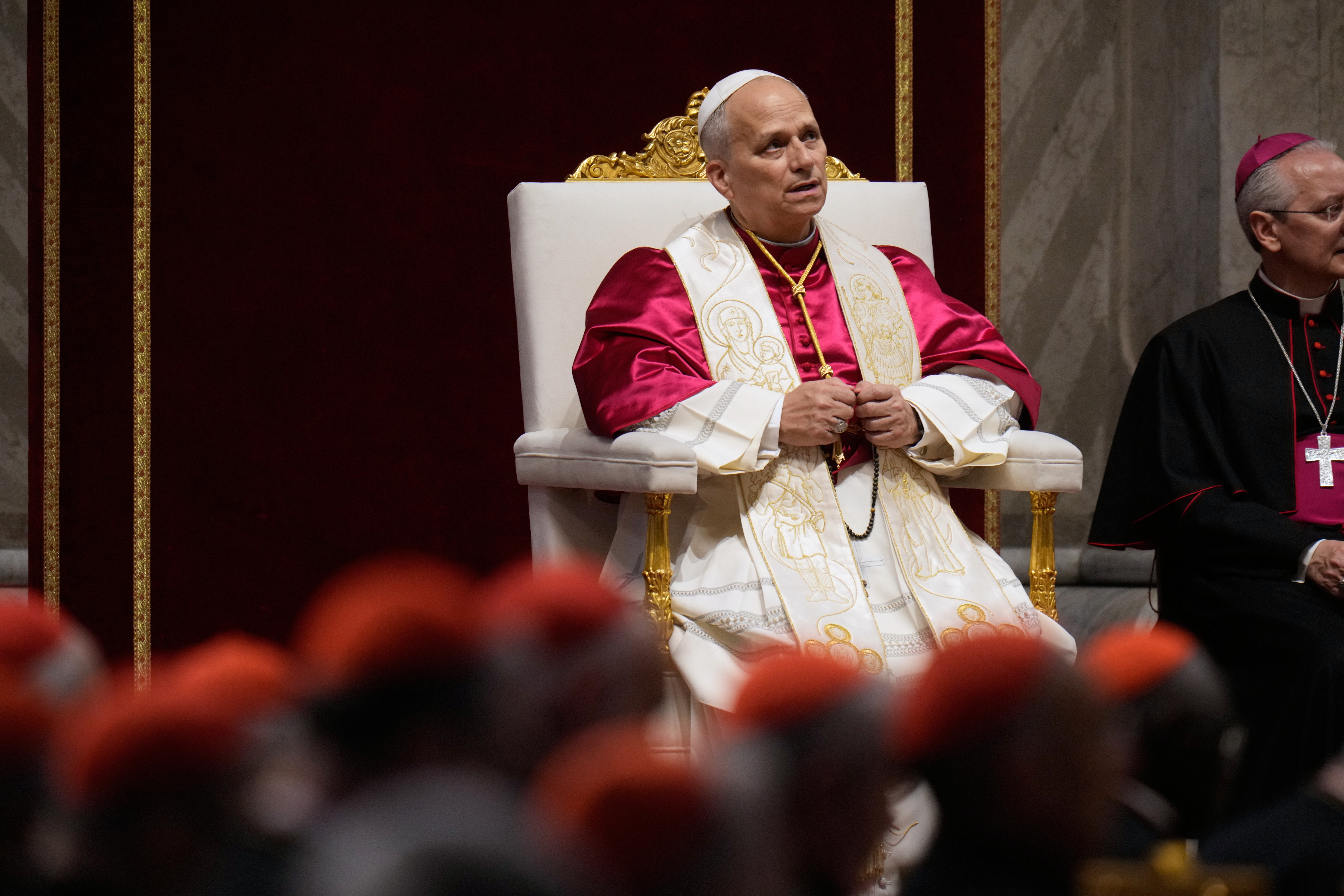
Pope Leo has shattered the traditional diplomatic silence of the Holy See to label the current U.S.-Israeli military campaign in Iran a product of a "delusion of omnipotence." This isn't just another plea for peace from a religious figure. It is a targeted critique of the strategic logic driving the escalation in the Middle East. The Pope’s assessment targets the belief that superior technology and fire-power can reshape an ancient civilization without triggering a global catastrophe. By framing the conflict as a psychological failure of leadership in Washington and Jerusalem, the Vatican is signaling that the moral and practical justifications for this war have collapsed.
The Theology of Intervention
The Vatican’s shift from generic pacifism to specific geopolitical critique reveals a deep anxiety about the nature of modern warfare. Leo’s use of the term "delusion" suggests that the architects of the strikes on Iranian soil are operating outside the bounds of historical reality. This is a direct shot at the "surgical strike" philosophy. For decades, military planners have sold the idea that a high-precision air campaign can neutralize nuclear ambitions or topple regimes with minimal collateral damage.
History rarely follows the script written by the side with the most satellites. The Vatican’s intelligence network, which remains one of the most sophisticated in the world, sees a different outcome. They see a protracted regional firestorm that the West is fundamentally unprepared to extinguish. When the Pope speaks of a "delusion of omnipotence," he is referencing the hubris of thinking a conflict with a nation of 90 million people can be contained within a digital simulation or a 72-hour bombing window.
The Mechanics of the Escalation
To understand why the Vatican is so alarmed, one must look at the specific military triggers currently in play. The joint U.S.-Israeli operations have moved beyond sabotaging enrichment facilities. We are now seeing the systematic targeting of command-and-control infrastructure and conventional military assets. This shift changes the math for Tehran.
In the past, Iran relied on its "forward defense" strategy, using regional proxies to keep the fight away from its borders. The direct strikes have stripped away that buffer. This leaves the Iranian leadership with two choices: total capitulation or a maximum-pressure response that targets global energy chokepoints. The Strait of Hormuz is the most obvious target. Approximately 20% of the world's petroleum passes through that narrow waterway. If the "delusion" Leo speaks of persists, the economic fallout will hit the world's poorest populations the hardest, which is where the Church’s primary concern lies.
The Intelligence Failure of Confidence
The current strategy relies on the assumption that the Iranian populace will turn against the government once the bombs start falling. This is a recurring mistake in Western foreign policy. External threats often have the opposite effect, forcing domestic critics to rally around the flag out of survival.
Military analysts in the Pentagon and the IDF believe they have mapped every relevant silo and bunker. They haven't. The geography of the Iranian plateau is a natural fortress. Deeply buried facilities like Fordow are designed to withstand exactly the type of ordnance currently being deployed.
The "omnipotence" the Pope mentions is the belief that there is no problem a GBU-57 Massive Ordnance Penetrator cannot solve. This ignores the social and political radiation that follows such an explosion. Even if the nuclear program is set back by years, the motivation to rebuild it becomes a matter of national survival. You cannot bomb a country into wanting less security.
The Israeli Calculus and the American Shield
Israel views the Iranian nuclear program as an existential threat that overrides all other diplomatic concerns. For Jerusalem, the risk of action is high, but the risk of inaction is perceived as total. This creates a feedback loop where every tactical success—a successful drone strike or a cyber-attack—reinforces the idea that more force is the only solution.
The United States finds itself in a precarious position. While providing the logistics and intelligence necessary for these operations, Washington is also trying to prevent a total collapse of global markets. This creates a fragmented policy. One hand signs off on target lists while the other attempts to de-escalate through backchannels. The Pope’s critique hits this specific contradiction. You cannot claim to be a peacemaker while providing the fuel for an unprecedented regional war.
The Global South and the Moral Deficit
The Vatican’s voice carries significant weight in the Global South, particularly in Latin America and parts of Africa. These regions view the U.S.-Israeli campaign not as a security necessity, but as a continuation of Western hegemony. By labeling the war a "delusion," the Pope is providing a moral vocabulary for countries that are already skeptical of the U.S.-led international order.
This creates a diplomatic vacuum. If the moral high ground is ceded, the ability to build a broad coalition for sanctions or post-war reconstruction vanishes. We are seeing a world where the West is increasingly isolated in its conviction that military force is a viable tool for political change. The "omnipotence" isn't just about military might; it’s about the perceived right to dictate the internal affairs of a sovereign nation through violence.
The Economic Ghost in the Machine
The Vatican isn't just worried about souls; it's worried about the global economy. A full-scale war in Iran would likely push oil prices past $150 a barrel. This would trigger an inflationary spiral that would dwarf the 2022 energy crisis.
- Supply Chains: Microchip manufacturing and global logistics would face immediate disruptions.
- Refugee Crisis: A destabilized Iran would send millions of people toward Europe and Turkey, further straining the social fabric of those regions.
- Debt Cycles: Rising interest rates to combat inflation would push developing nations into default.
The Pope understands that the poorest people—the ones his institution claims to represent—will pay the highest price for a war they have no stake in. The "delusion" is thinking that a conflict in the Middle East can be quarantined. In a hyper-connected world, there are no local wars.
The Failure of the "Clean" War Narrative
There is a concerted effort by defense contractors and political spokespeople to frame this as a "clean" conflict. They use terms like "neutralization" and "kinetic solutions" to mask the reality of what is happening on the ground. The reality is messy. It is loud. It is bloody.
When the Vatican breaks rank, it forces a pause in this narrative. The Pope’s statement acts as a "sanity check" for a global audience that has become desensitized to the language of precision warfare. He is reminding the world that behind every strategic objective is a human cost that cannot be calculated in a situation room.
The Shift in Vatican Diplomacy
This is not the Vatican of the 20th century. Under Leo, the Holy See has become more aggressive in its critiques of Western military policy. This stems from a realization that the traditional methods of behind-the-scenes mediation are failing. The "delusion of omnipotence" is a diagnosis of a system that no longer listens to nuance.
By going public with such a harsh critique, the Pope is attempting to create a "Third Way" for leaders who are uncomfortable with the current trajectory but feel pressured to align with the U.S.-Israeli axis. It is a call for a return to realism. Realism acknowledges that some problems cannot be solved with a missile, and that the attempt to do so often creates a much larger, more dangerous problem.
The Intelligence Gap in the West
A significant part of the "delusion" comes from a lack of genuine understanding of the internal dynamics of the Iranian state. Western intelligence often relies on exiled groups or technological signals, which can create a distorted picture. They see a regime on the brink of collapse. They see a military that is a paper tiger.
Historical precedent suggests otherwise. Iran has shown a remarkable ability to endure economic hardship and military pressure while maintaining its core strategic objectives. The assumption that one more round of strikes will be the "game-changer" is the very definition of the delusion Leo is warning against. It is a cycle of escalation where the exit ramp is blocked by the pride of the participants.
The Vatican’s intervention is a reminder that power is not just the ability to destroy; it is the wisdom to know when destruction serves no purpose. The "delusion of omnipotence" is the belief that the world is a chessboard when it is actually a complex, living ecosystem. If you burn one part of it, the smoke eventually chokes everyone.
The current path leads to a regional confrontation that no one can control once it begins. The only way out is to abandon the fantasy that total military dominance is a substitute for difficult, frustrating, and often unsatisfying diplomacy. The bombs are already falling, but the window to prevent a total global fracture is closing rapidly.
Stop looking for a clean ending to a conflict that is inherently dirty.