The granite does not care that you are seven years old.
To the massive, shifting tectonic soul of Yosemite’s El Capitan, 3,000 feet of sheer, polished stone is simply a fact of geography. It is cold. It is blank. It features cracks thinner than a deck of cards and drop-offs that turn fully grown men into weeping statues of terror. Climbers spend lifetimes conditioning their fingers to resemble steel cables just to survive a weekend on its face.
Then came Joey Danger.
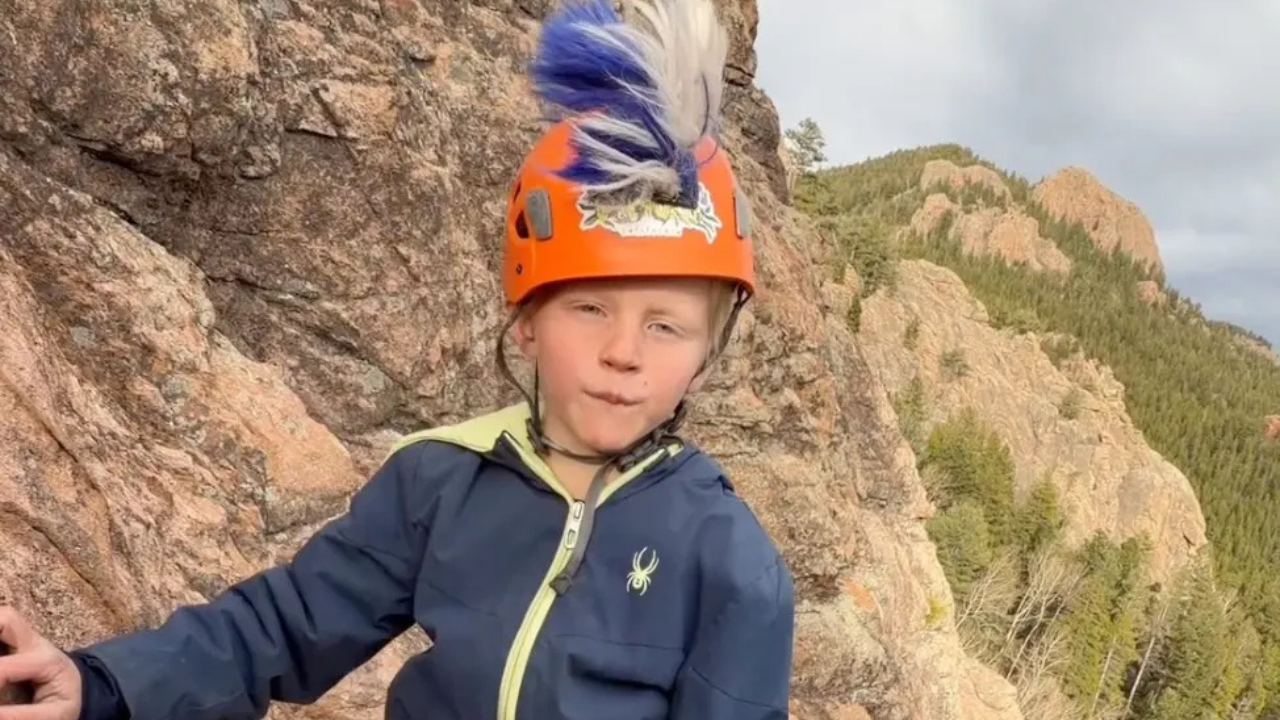
He doesn't look like an apex predator of the vertical world. He looks like a kid who should be arguing about bedtime or skinning his knees on a suburban sidewalk. Yet, there he was, suspended 2,000 feet in the open air, his small chalk-covered fingers seeking friction on holds that most adults can barely see. Over five grueling days, this seven-year-old boy traded the safety of the playground for the ultimate vertical crucible.
He wasn't just climbing. He was redefining what we think children are capable of when we stop wrapping them in bubble wrap.
The Weight of the Valley
If you have never stood at the base of El Capitan, it is difficult to communicate the sheer psychological gravity of the place. The meadow below is quiet, filled with tourists holding binoculars, squinting at microscopic dots moving across the gray expanse.
When you look up, your neck aches. Your brain struggles to process the scale. It feels less like a mountain and more like a frozen wave of stone threatening to collapse onto the valley floor.
For decades, this was the exclusive playground of the hardened, the eccentric, and the obsessed. Men and women who lived out of the trunks of their cars, eating cold beans from cans, dedicating their entire existences to mastering the subtle geometry of the rock. It is a subculture built on grit and an intimate familiarity with risk.
To bring a child into this environment feels, to the uninitiated, like madness.
The critics wasted no time. As news of Joey’s attempt trickled down the valley and onto the internet, the collective intake of breath was audible. Parents murmured about exploitation. Traditionalists questioned the ethics of placing a second-grader in a high-consequence environment.
But those voices missed the fundamental truth of the expedition. This wasn't a case of living vicariously through a child. This was about a boy who looked at a mountain and saw the ultimate playground.
Consider the mechanics of a five-day ascent. You do not simply climb until you are tired and then walk to a hotel. You live on the wall.
Every piece of food, every drop of water, every sleeping bag must be hauled up the rock face using complex systems of ropes and pulleys. When night falls, you don't sleep on solid ground; you sleep on a portaledge—a collapsible fabric platform suspended over thousands of feet of absolutely nothing.
Imagine waking up in the middle of the night. You shift your weight, and the nylon beneath you groans. You look over the edge, and the darkness below is bottomless. For a grown adult, that realization can trigger a primal, paralyzing panic.
For Joey, it was just Tuesday.
The Chemistry of Fear
Why do we assume kids can't handle this?
Adults carry a heavy, invisible backpack filled with a lifetime of accumulated anxieties. We know what a broken bone feels like. We understand the finality of death. We know the cost of failure.
A seven-year-old’s relationship with fear is different. It is purer. Fear for a child is not a lingering, existential dread about the future; it is an immediate, physical sensation that can be acknowledged, managed, and moved past.
During the third day of the climb, the team hit a notorious section of the route. The wind began to howl through the canyon, whipping the ropes into chaotic arcs. The granite grew slick with condensation. Progress slowed to a crawl.
A standard seven-year-old might throw a tantrum. A standard adult might call for a rescue helicopter.
Joey simply adjusted his helmet, found a tiny pocket for his foot, and kept moving.
His father, an experienced climber who managed the safety systems with meticulous precision, watched his son navigate the crisis not with the grim determination of a soldier, but with the focused intensity of a child building a Lego set.
This is the secret that the headlines missed. The world record—becoming the youngest person to ever scale El Capitan—is a fascinating statistic for trivia books. But the record is the least interesting part of the story.
The real magic lay in the micro-moments. It was the way Joey’s small hand looked against the ancient, weathered stone. It was the quiet conversations between father and son during the long afternoons on the portaledge, sharing a bag of candy while suspended in the clouds.
The New Definition of Safety
We live in an era obsessed with eliminating risk. We pad our playgrounds, monitor our children’s locations via GPS, and curate their experiences to ensure they never encounter discomfort or failure.
We think we are protecting them. In reality, we might be starving them.
By removing every obstacle, we deprive children of the opportunity to discover their own resilience. Joey Danger’s five-day odyssey challenges this modern philosophy. It forces us to ask a uncomfortable question: Are we setting the bar too low for the next generation?
Safety on a rock face like El Capitan is not about luck. It is about a rigorous, unyielding commitment to system redundancy. Every rope is backed up. Every anchor is checked multiple times. Joey was never in free-fall danger; he was encased in a web of modern engineering and parental vigilance.
The danger wasn't physical. It was psychological. And that is exactly where the boy thrived.
Where an adult sees a terrifying void, a child sees space. Where we see a grueling ordeal, he saw an adventure with his dad. The five days blurred into a rhythm of effort, rest, and wonder. He watched eagles soar below him. He saw the sunset paint the High Sierra in shades of bruised purple and gold from a vantage point that fewer than one percent of humanity will ever experience firsthand.
The View from the Top
On the fifth day, the angle of the rock finally began to ease. The vertical wall gave way to slabs, and the slabs turned into the flat, forested summit of El Capitan.
There were no cheering crowds at the top. No brass bands. Just the wind blowing through the pine trees and the quiet satisfaction of a job finished.
Joey stepped onto the flat ground, his legs slightly shaky after nearly a week of living in the air. He didn't thump his chest. He didn't give a grand speech about human potential or breaking barriers.
He asked for a snack.
The world will look at Joey Danger and see a prodigy, a record-breaker, an anomaly. They will debate whether it was responsible or reckless, inspiring or insane.
But as the sun began to dip below the horizon, casting long shadows across the Yosemite valley floor far below, the boy wasn't thinking about the record books. He was looking at his dirty hands, his worn-out climbing shoes, and the vast expanse of the world stretching out before him, suddenly looking a little less intimidating than it did five days ago.
The granite still didn't care. But the boy would never look at a wall the same way again.