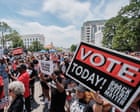
The national narrative surrounding voting rights in the American South usually follows a predictable, well-rehearsed script. Thousands gather on the steps of a historic capitol, leaders deliver soaring rhetoric about the civil rights movement, and national commentators decry the latest legislative map as a relic of a darker past. But behind the optics of the recent mass rallies in Montgomery, where thousands protested Alabama’s racially gerrymandered congressional districts, lies a much colder, more calculating political mechanism. The true battleground for Black voting rights is not the courthouse steps or the statehouse rotunda. It is found in the precise, algorithmic manipulation of demographic data designed to dilute minority political power before a single ballot is ever cast.
Activists who mobilized across Alabama are responding to a sophisticated legal strategy. By repeatedly defying federal court orders to create a second majority-Black congressional district, Alabama lawmakers did not just stumble into a constitutional crisis. They engineered one. This resistance is a deliberate effort to force the U.S. Supreme Court to reconsider the core tenets of the Voting Rights Act of 1965. Understanding this reality requires looking past the protest signs and examining the structural architecture of modern disenfranchisement.
The Mathematics of Disenfranchisement
To understand how Alabama’s political boundaries function, one must look at the geography of the Black Belt. Named originally for its rich, dark soil, this region across the middle of the state is home to the majority of Alabama’s African American population. For decades, state mapmakers used two primary techniques to neutralize this voting bloc. These methods are packing and cracking.
Packing involves shoving as many Black voters as possible into a single congressional district. In Alabama, this is District 7, represented for years by the state's lone Democratic congressional member. By concentrating Black voters from Birmingham, Montgomery, and the rural Black Belt into this single district, mapmakers created an intentional surplus of minority votes. District 7 routinely elects a candidate of choice with overwhelming majorities, often exceeding 70 percent of the vote.
Cracking is the inverse strategy. The remaining Black communities across the state are split apart and distributed into surrounding, predominantly white rural districts. For example, a Black neighborhood in a city like Mobile might be grouped with white voters living over a hundred miles away in the wiregrass region. The result is that these minority voters are perpetually outnumbered. They cannot elect their preferred candidates.
This is not a matter of accidental geography. Modern mapmaking relies on sophisticated Geographic Information System software. Mapmakers can view demographic data down to the census block level, allowing them to draw lines that divide specific neighborhoods, sometimes even individual streets, to achieve a desired political outcome. When thousands of Alabamians marched on the state capitol, they were not just protesting abstract prejudice. They were protesting a highly technical, data-driven system designed to make their votes statistically irrelevant.
The Supreme Court High Stakes Gamble
The immediate catalyst for the widespread protests was the state legislature's refusal to comply with a direct mandate. In a surprising ruling, the U.S. Supreme Court affirmed a lower court decision stating that Alabama’s map likely violated Section 2 of the Voting Rights Act. The court ordered the state to draw a map that included either a second majority-Black district or an additional district where Black voters would have an opportunity to elect a candidate of their choice.
Instead of complying, the Alabama legislature passed a new map that defied the court's explicit instruction. The new boundaries raised the percentage of Black voters in the second congressional district slightly, but kept it well below a level where minority voters could reliably win an election.
This open defiance baffled national political observers, but it makes perfect sense within the context of long-term judicial strategy. Alabama’s political leadership is playing a long game. They recognize that the Supreme Court’s conservative majority has spent the last decade systematically weakening federal voting protections. The landmark ruling in Shelby County v. Holder effectively eliminated the preclearance requirement, which previously forced states with histories of discrimination to approve new maps with the Department of Justice before they could take effect.
By returning to the courts with a map that barely altered the status quo, Alabama was testing the resolve of the judiciary. The state's legal architects are betting that if they stretch the litigation out long enough, they can either exhaust the resources of civil rights organizations or find a new legal vulnerability in Section 2 of the Voting Rights Act. It is a calculated gamble that views federal lawsuits not as binding orders, but as opening bids in a prolonged negotiation.
The Ground Level Reality of the Rural Black Belt
While the legal battles play out in federal courts, the human cost of this political manipulation is borne by the residents of the Black Belt. This region suffers from some of the most severe poverty and systemic neglect in the nation. Infrastructure is failing. In many rural counties, a lack of municipal sewage systems means residents must rely on straight-piping, a practice where raw sewage is discharged directly into open trenches behind homes.
There is a direct correlation between this lack of infrastructure and the dilution of political power. When a community lacks effective representation in Congress, it loses its leverage to secure federal funding, infrastructure grants, and economic development projects. Representatives who do not rely on Black voters for re-election have little incentive to address the unique, structural crises facing these neglected communities.
Economic and Health Disparities in Alabama's Congressional Districts
| District | Predominant Demographics | Access to Local Hospital Care | Household Income Compared to State Average |
|---|---|---|---|
| District 7 (Packed Minority) | Overwhelmingly Minority | High Closure Rates / Severe Shortages | Significantly Below Average |
| Districts 1-6 (Cracked/White Majority) | Predominantly White | Stable Regional Medical Centers | At or Above Average |
During the rallies, local organizers repeatedly emphasized that voting rights are not a luxury. They are a tool for survival. Without a representative who is accountable to the Black Belt, the region remains trapped in a cycle of underfunding and neglect. The fight over congressional lines is ultimately a fight over who controls the distribution of federal resources for healthcare, education, and clean water.
The Structural Limits of Mass Mobilization
The thousands of citizens who took to the streets demonstrated a profound, resilient commitment to democratic participation. Yet, an objective analysis of Southern politics reveals that mass mobilization faces severe structural limitations within a rigged system. Protests can shift public awareness and energize a base, but they cannot rewrite statutory boundaries or override gerrymandered majorities.
The reality of Alabama’s political structure is that the ruling party is largely insulated from the political fallout of these protests. Because the state’s legislative districts are themselves heavily gerrymandered, the lawmakers who drew the non-compliant congressional maps face virtually no risk of losing their seats in a general election. Their only real vulnerability is a primary challenge from the right. In that political environment, defying federal judges and civil rights groups is not a political liability. It is a campaign asset.
Furthermore, relying solely on national pressure campaigns ignores the deep polarization of the local electorate. The national media coverage of the Montgomery rallies often portrayed the events as a wake-up call for the state. In practice, however, the state's dominant political apparatus views national condemnation as validation. It signals to their base that they are standing firm against outside interference.
A Systemic Crisis with No Easy Fix
The legal battle over Alabama's congressional map will eventually reach a conclusion, but the broader crisis of structural disenfranchisement will persist. Even if courts successfully force the implementation of a fairer map, the underlying mechanisms of political control remain intact. Independent redistricting commissions, which have been used in other states to mitigate partisan gerrymandering, are a political impossibility in Alabama, where the legislature holds absolute control over the process.
Civil rights organizations face an uphill battle. Litigation is extraordinarily expensive and takes years to wind through the court system, during which time multiple election cycles can occur under unconstitutional maps. By the time a court finalizes a remedy, the political damage has already been done, policies have been passed, and judicial appointments have been secured.
The modern struggle for voting rights in the South cannot be won by romanticizing the past or relying on the tools of a bygone era. The tactics of the 1960s were designed to confront overt, explicit barriers like literacy tests and poll taxes. Today's barriers are subtle, mathematical, and wrapped in the language of legal technicalities. Defeating them requires an equally sophisticated, data-driven approach that confronts the mechanics of power where they actually live: in the code, the census blocks, and the long-term judicial strategies designed to insulate power from the changing demographics of the nation.