The heat in New Delhi does not just sit on you. It interrogates you. By 2:00 PM, the asphalt of New Delhi breathes a suffocating, petrol-soaked mist that softens the rubber of your shoes. If you are stuck in the middle of a six-lane bottleneck near Connaught Place, the noise is a physical wall. Horns do not mean "get out of the way" here. They mean "I exist."
In the middle of this chaos sits Ramesh. He is forty-two, though his forehead suggests fifty, and his hands are permanently stained with a mixture of engine oil and cheap tobacco. Ramesh drives a three-wheeled, open-air motorized rickshaw—an autorickshaw. It is a fragile shell of sheet metal painted bright yellow on top and forest green on the bottom.
For twelve hours a day, Ramesh operates within a moving ecosystem of millions. To survive, his vehicle cannot just be a machine. It must be an identity.
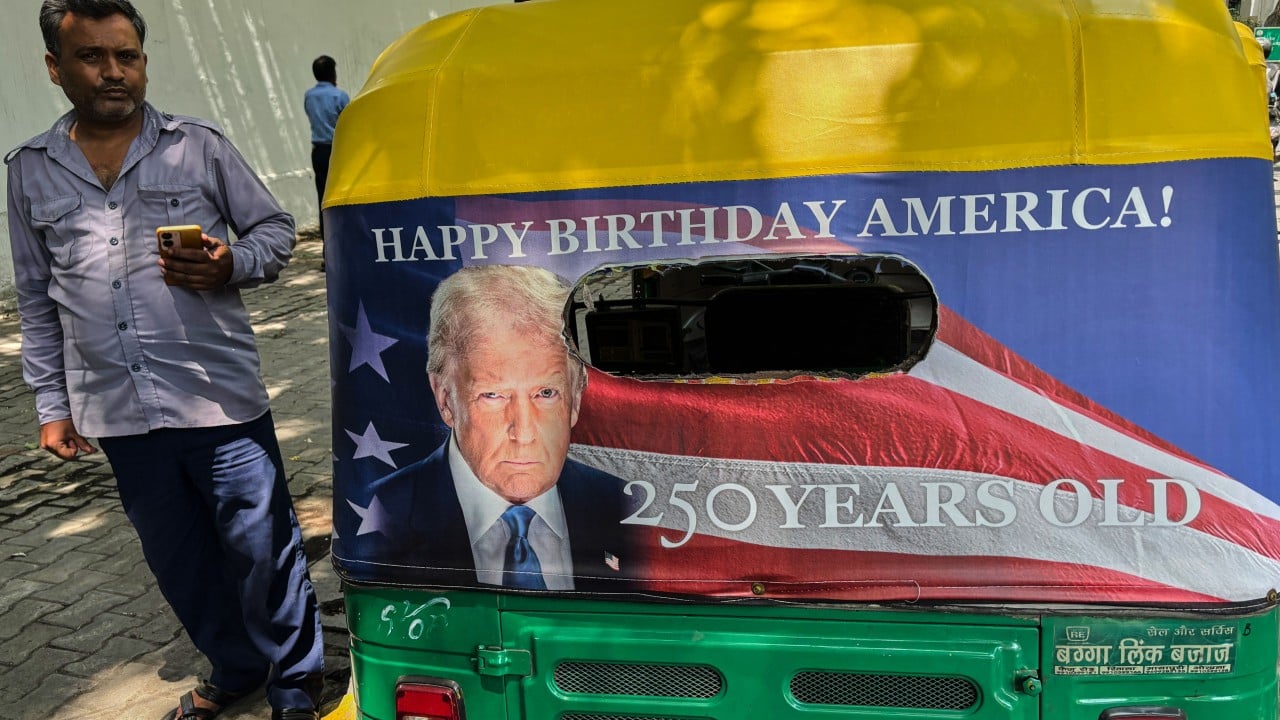
If you peer through the exhaust smog at the back of Ramesh’s vehicle, past the dangling black threads meant to ward off the evil eye, you will see a face staring back at you from a vinyl sticker. It is not a Bollywood star. It is not Ganesha, the elephant-headed remover of obstacles, though there is a small plastic idol of him on the dashboard. It is Donald Trump.
He is smiling a jagged, low-resolution pixelated smile, framed by a shock of bright yellow hair that perfectly matches the roof of the rickshaw.
This is not an isolated political statement. Across the vast, sprawling urban centers of India, from the tech hubs of Bengaluru to the ancient alleys of Varanasi, Western political figures are plastered onto the bumpers of local transit. It baffles foreign tourists. It confuses political analysts who try to map Western ideological spectrums onto the global south. But to understand why an American billionaire is riding shotgun on a three-wheeled taxi in India, you have to understand the hyper-local survival strategy of the street.
The Canvas of the Road
In the West, a car is often a private bubble. Tinted windows roll up, air conditioning hums, and the outside world is muted.
An autorickshaw is the exact opposite. It is a public stage. The driver is exposed to the elements, the passengers are exposed to the driver, and the entire vehicle is exposed to every passing stranger. Because these drivers spend their lives in the public eye, their vehicles become a canvas for communication.
Step back and look at the visual language of an Indian street. Drivers decorate their rigs with a complex hierarchy of symbols. First come the gods, placed on the dashboard to ensure the brakes do not fail on the highway. Next come the slogans, usually warnings to tailgaters: Blow Horn or Use Dipper at Night. Then come the pop culture icons—action heroes who represent strength, defiance, or wealth.
For decades, those icons were local. You would see Amitabh Bachchan staring fiercely from a mudguard, or Rajinikanth flipping a cigarette on a bumper. These were men who rose from nothing, characters who beat the corrupt system with their fists and their wits.
But over the last decade, something shifted. The local heroes started sharing space with global titans.
Consider how information travels now. Ramesh does not read the New York Times. He does not watch cable news. But he has a cheap smartphone, a Jio data plan that costs less than a cup of tea, and an algorithm that feeds him short, punchy videos on YouTube and WhatsApp. In these videos, the complexities of international trade, geopolitics, and constitutional law are stripped away. What remains is pure theater.
To the men who navigate the brutal hierarchy of urban Indian traffic, the version of Donald Trump they see on their screens is not a policy maker. He is a character from a movie. He is loud. He breaks the rules. He speaks in short, aggressive sentences. Most importantly, he fights people who look important.
To a driver who gets pushed around by traffic police, dismissed by wealthy passengers, and ignored by the state, that specific archetype is intoxicating. It is a subversion of power. Putting that face on a vehicle is a way of saying, "I am small, but I am aligned with something massive."
The Economy of a Sticker
There is a pragmatic side to this folklore. The street economy operates on immediate impressions.
Imagine a young tech worker in Gurgaon stepping out of an air-conditioned glass tower. She needs a ride to the metro station. There are twenty rickshaws lined up, all identical, all charging the same fare. How does she choose?
She chooses the one that catches her eye. A stark, bright vinyl cutout of a global figure stands out in a sea of faded paint. It is a conversation starter. It signals that the driver is aware of the world outside the neighborhood. It is, in a very strange way, a marketing gimmick.
"Passengers ask about it," Ramesh says, gesturing toward the back of his seat. He speaks in Hindi, his voice competing with the rattle of his two-stroke engine. "They laugh. They take photos for their phones. If they are laughing, they do not argue so much about the price when we arrive."
In the harsh math of the gig economy, where a difference of twenty rupees can mean the difference between buying milk or going without, anything that reduces friction with a customer is a tool worth using. The sticker costs fifty rupees at a roadside stall. If it brings in two extra fares a week because someone thinks it is funny or strange, the investment pays off immediately.
But the phenomenon goes deeper than mere commerce. It reflects a changing relationship with the West.
For generations, the narrative of success in India was one of migration. You studied hard, you got a visa, and you left for London or Silicon Valley. The West was a distant, polished place of perfection.
The digital age flattened that distance. Through the lens of social media, the chaos of Western politics looks remarkably similar to the chaos of Indian politics. The prestige has been stripped away, replaced by raw, unvarnished spectacle. When Indian drivers put these images on their vehicles, it is not an act of worship. It is an act of normalization. They are bringing the icons of global power down into the dust, the heat, and the traffic where everyone else has to fight for space.
The View from the Driver’s Seat
It is easy to over-analyze this from a distance. You can look at the data of smartphone penetration in India, the rise of digital populist movements, or the intersection of global media consumption. You can write essays on the semiotics of transportation decor.
But the truth is much closer to the ground.
As the traffic light changes from red to a flashing yellow, Ramesh shifts his vehicle into first gear with a heavy, metallic clunk. The rickshaw jerks forward, vibrating violently as it accelerates into the gap between a luxury German sedan and a crowded public bus.
He does not care about foreign policy. He does not care about elections held on the other side of the planet. He cares about the pothole three feet in front of his tire, the price of compressed natural gas, and whether he can finish his shift before the evening monsoon rains turn the streets into rivers.
Behind him, stuck to the scratched green metal, the yellow-haired caricature moves through the Delhi smog, getting pelted by road gravel, covered in soot, and splashed with muddy water. It is a tiny, absurd monument to a hyper-connected world where a billionaire can become a talisman for a man making five dollars a day.
The rickshaw disappears into the crowded market street, weaving through the bicycles and the pedestrians, its engine roaring, carrying its strange passenger into the heat.