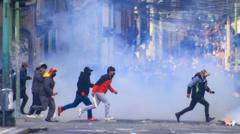
La Paz is choking on tear gas again. The streets outside the presidential palace are filled with the sound of exploding dynamite sticks and the shouts of thousands of angry citizens. If you've been watching South America lately, this feels like a grim movie on repeat. But the latest clashes between anti-government demonstrators and riot police aren't just another standard protest. They represent the complete breakdown of a high-stakes economic experiment.
Six months ago, President Rodrigo Paz took office as a business-friendly centrist, breaking two decades of socialist rule. He promised to rescue Bolivia from its worst financial tailspin in forty years. Instead, the country has ground to a halt. Miners, indigenous groups, and farmers have blocked major highways, cutting off food, fuel, and medical supplies to the capital. The situation boiled over into outright street warfare as protesters tried to storm government headquarters.
This isn't a random outburst of anger. It's the inevitable result of a country running out of money, options, and patience.
The Economic Spark That Lit the Fuse
To understand why a 60-year-old farmer would travel 90 kilometers from Caquiaviri just to face down riot police, you have to look at the numbers. Bolivia's year-on-year inflation hit a staggering 14% in April. But the real crisis lies in what people can actually buy.
For twenty years, Bolivians relied on heavily subsidized fuel. It kept the economy moving, but it drained the central bank's foreign reserves. When President Paz took office, the treasury was basically empty of U.S. dollars. In December 2025, he signed Supreme Decree 5503, completely scrapping those two-decade-old fuel subsidies.
The backlash was instant and brutal.
- Skyrocketing Costs: Diesel and gasoline prices surged overnight, dragging the price of food, transit, and basic goods up with them.
- Severe Scarcity: Despite lifting the subsidies, the government couldn't stabilize the supply. Drivers now spend days waiting in lines at service stations.
- The Dollar Drought: Without greenbacks, businesses can't import raw materials, creating shortages of everything from basic medicine to manufacturing components.
Paz briefly rolled back parts of his economic decree after an initial wave of fury in January, but the structural damage was already done. The government tried to push austerity, but a population raised on state protections wasn't going to take it lying down.
A Dangerous Political Ghost Story
You can't talk about Bolivian unrest without talking about Evo Morales. The former iconic socialist president, who ruled from 2006 to 2019, is pulling the strings from his stronghold in the remote tropical lowlands. Morales is currently facing an arrest warrant for statutory rape and was recently held in contempt of court for refusing to show up to his trial. He claims the charges are purely political, a strategy to keep him from running for office again.
Morales's loyalists used his legal troubles and the economic pain to launch a massive, seven-day march covering 180 kilometers from Oruro to La Paz. They arrived with a clear demand: President Paz must resign.
Conservative politicians are screaming for Morales to be locked up immediately. They accuse him of using vulnerable rural communities as human shields to escape jail. Morales hits back on social media, arguing that the people are driven by their own fury against a administration that betrayed them. Honestly, both things can be true at once. Morales is absolutely using the crisis for political survival, but he couldn't mobilize thousands of people if the economic suffering wasn't deeply real.
Dynamite Versus Tear Gas on the Streets
When the marchers finally hit La Paz, the city center transformed into a war zone. Miners, who have a long history of radical union activism in Bolivia, marched alongside indigenous groups and farmers. They didn't just bring signs; they brought small sticks of dynamite and firecrackers, hurling them directly at police lines near Plaza Murillo.
Riot police responded with overwhelming force. Thick clouds of tear gas blanketed the administrative capital, forcing lawmakers and government staffers to flee their offices. Protesters ripped shop doors off their hinges, dragged sofas into the streets, and set them ablaze to form burning barricades.
The human toll of this standoff is rising fast:
- Mass Arrests: Public prosecutors and local television networks report well over 100 demonstrators detained in the latest sweeps.
- Casualties: At least three people have died because the surrounding highway blockades prevented ambulances from reaching hospitals. Another protester died after falling into a ditch during highway skirmishes.
- Economic Paralysis: The Bolivian Highway Administration reported at least 28 active blockades choking off the nation's main arteries. Around 5,000 cargo trucks are currently stranded on the roads. Supermarket shelves are bare, and local shops have completely shuttered their windows out of fear of looting.
What Happens When the State Fights Back
President Paz is caught in an impossible balancing act. If he gives in to the protestors and restores the massive subsidies, the country faces literal bankruptcy. If he stays the course with austerity, the streets will keep burning.
Right now, the government is leaning hard into a security-first approach. A joint force of 3,500 police officers and military personnel has been deployed to forcefully clear the highway barricades. Even more alarming for human rights groups is a pair of "anti-blockade" bills currently moving through the Bolivian Congress. These laws would criminalize road protests with prison sentences of up to 20 years.
International neighbors are getting nervous. A coalition of regional governments—including Argentina, Chile, Paraguay, and Peru—issued a joint statement backing President Paz, rejecting the street violence as an attempt to destabilize democratic order. They want stability, but forcing stability with a club rarely works in Bolivia.
If you are planning to travel to South America right now, check the latest State Department alerts. Avoid the interior highways of Bolivia entirely. The political landscape is completely unpredictable, and a road that's clear in the morning can be a burning barricade by afternoon. Watch the actions of the Bolivian Workers' Center (COB) over the next 48 hours. If the country's largest trade union calls for an indefinite general strike alongside the miners, the Paz administration might not survive the month.
To learn more about the deep-seated roots of this crisis, you can watch this brief report on Bolivia's anti-government unrest, which shows firsthand footage of the clashes and the chaotic atmosphere surrounding the government palace in La Paz.