The global rush for gold has driven prices to unprecedented highs, but the hidden human cost of this boom is being paid by women working in small-scale, unregulated mines. In the Katoro goldfield within Tanzania’s northern Geita region, and across dozens of developing nations, women are handling liquid mercury with bare hands to extract gold from crushed ore. The immediate threat is not just structural collapse or economic exploitation, but the toxic fumes generated when the resulting mercury-gold amalgam is heated. This daily exposure has forced a devastating choice upon these workers, with the United Nations warning that the resulting health risks are compelling women in mining communities to delay or completely abandon motherhood out of fear of severe birth defects.
Artisanal and small-scale gold mining accounts for roughly 20 percent of the global gold supply. It is an industry fueled by systemic poverty, operating largely outside the bounds of formal regulation. Millions of independent miners rely on mercury because it is cheap, readily available, and highly effective at binding to microscopic gold particles. Once the amalgam is formed, it must be heated to vaporize the mercury, leaving behind raw gold. This burning often happens in domestic kitchens or poorly ventilated community spaces, transforming a workplace hazard into a permanent environmental contaminant that poisons entire households.
Monika Stankiewicz, Executive Secretary of the UN's Minamata Convention on Mercury, recently brought this crisis to light on the sidelines of the Eighth Global Environment Facility Assembly. Her field observations reveal a heartbreaking psychological shift among women in these regions. The fear of passing debilitating neurological damage to their unborn children has become a profound reproductive dilemma.
"I've heard women saying they are afraid to get pregnant because they are afraid their children will be affected by mercury. So it was really heartbreaking."
- Monika Stankiewicz, Executive Secretary of the Minamata Convention on Mercury
The medical reality justifies their terror. Liquid mercury is a potent neurotoxin that easily crosses the placental barrier, directly entering the circulatory system of a developing fetus. The resulting damage is permanent. It mirrors the tragic legacy of Minamata disease discovered in 1950s Japan, where industrial mercury dumping led to catastrophic brain damage, blindness, and severe motor dysfunction in children born to exposed mothers. In artisanal mining setups, women are frequently assigned the task of processing ore and supervising the burning process to prevent theft, placing them directly in the path of the highest chemical concentrations.
The Economic Trap of the Amalgam
Understanding why this practice persists requires looking at the raw economics of small-scale mining. A typical mining family survives on fluctuating day-to-day yields. Mercury acts as the ultimate equalizer for impoverished workers, allowing them to extract gold without expensive machinery or industrial processing plants.
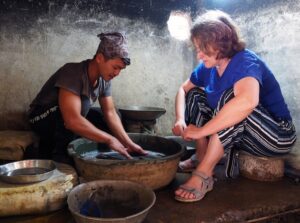
The division of labor within these mines is heavily gendered. While men typically handle the heavy excavation and deep shaft digging, women are relegated to the processing phase. This involves panning, mixing the crushed rock with liquid mercury, and burning off the chemical matrix. Because the gold amalgam represents the family’s immediate daily income, women are trusted to guard it closely. They carry the toxic mixture back to their homes, processing it over the same cooking fires used to prepare family meals.
The chemical transition is rapid and invisible. When heated, liquid mercury transforms into an odorless vapor. Inhaling these fumes delivers the toxin straight to the lungs, where it enters the bloodstream and migrates to the central nervous system. Chronic exposure manifests in adults as tremors, severe memory loss, respiratory failure, and profound kidney damage. For a pregnant woman, the body acts as a conduit, concentrating the heavy metal into the fetus, often at levels higher than those measured in the mother's own blood.
Downstream Devastation and the Broken Supply Chain
The crisis cannot be contained within the boundaries of mining camps like Geita or the remote reaches of the Peruvian Amazon. Mercury is an element that does not break down in the environment. Instead, it enters global ecosystems, undergoing a chemical transformation into methylmercury when it hits water systems.
+------------------------+---------------------------------------------------------+
| Exposure Pathway       | Public Health and Environmental Impact                  |
+------------------------+---------------------------------------------------------+
| Direct Vapor Inhalation| Acute respiratory illness, tremors, adult brain damage  |
| Domestic Burning       | Chronic household contamination, childhood exposure     |
| Aquatic Runoff         | Methylmercury accumulation in local fish populations   |
| Placental Transfer     | Irreversible fetal neurological defects, cognitive loss |
+------------------------+---------------------------------------------------------+
As mining operations dump waste tailings directly into nearby streams, the toxin flows downstream. It enters the food chain, bioaccumulating in fish and traveling through indigenous food networks. This creates a secondary crisis for communities hundreds of miles away from the nearest gold mine. Populations in small island developing states, who rely heavily on marine diets, frequently test for dangerous mercury levels without ever having stepped foot near a mining site.
This reality exposes the limitations of localized intervention. While international bodies push for the adoption of mercury-free extraction technologies, such as retorts that capture and condense the vapor, adoption rates remain low. Retorts require an upfront capital investment that independent miners simply cannot afford. Furthermore, the formalization of the artisanal mining sector is painfully slow, hindered by corruption, remote geography, and a lack of political will from governments that benefit from the undeclared influx of gold bullion into national economies.
The Illusion of Choice
The global community has attempted to address this via the Minamata Convention, an international treaty designed to protect human health and the environment from anthropogenic emissions of mercury. On paper, the treaty mandates a phase-down of mercury use and encourages nations to integrate public health strategies into their mining policies.
The implementation on the ground tells a very different story. For an independent miner in Tanzania or Brazil, the choice between long-term toxic accumulation and immediate economic survival is no choice at all. Without gold, there is no food. The immediate necessity of feeding existing children consistently outweighs the abstract, terrifying risk of future reproductive complications.
True reform requires shifting the economic burden away from the individual miner. Programs that provide direct access to fair-trade gold markets, conditional on mercury-free processing, offer a potential path forward. These initiatives remain small, localized, and chronically underfunded. Until international buyers and consumers demand absolute traceability in the gold supply chain, the demand for cheap, unrefined gold will continue to incentivize the destruction of young lives.
The global gold market thrives on abstraction, hiding the ecological and human toll behind clean bars of bullion and high-end jewelry. For the women working the Katoro goldfields, the reality is entirely physical, measured in the heavy weight of toxic liquid and the agonizing decision to halt their own bloodlines to save their future children from a poisoned inheritance.