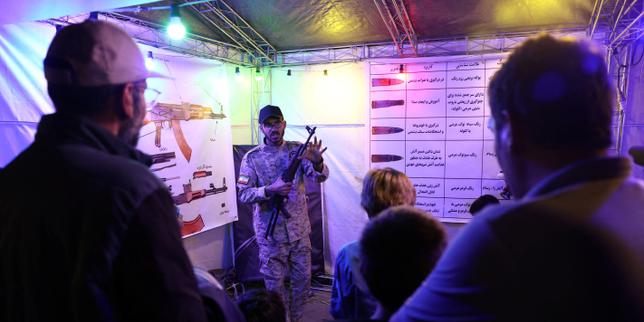
The statement by the Iranian military warning of "new fronts" in response to potential American actions marks a shift from reactive proxy management to a formalized doctrine of distributed deterrence. While conventional reporting treats these declarations as rhetorical posturing, a structural analysis reveals an underlying operational framework designed to exploit asymmetry in the Middle East. The strategic objective is not to win a conventional conflict against a superpower, but to alter the cost function of American intervention to a degree that renders kinetic action politically and economically unviable.
Understanding this strategy requires moving past political commentary and dissecting the specific logistical, geographic, and military vectors that Iran manipulates. The regional security architecture is governed by a clear calculus: distributed risk, asymmetric denial of access, and the weaponization of economic choke points.
The Tri-Border Friction Vector and Proxy Distribution
Iran's "new fronts" doctrine relies on a decentralized network of state and non-state actors often referred to as the Axis of Resistance. From a military standpoint, this network functions as a distributed force multiplier. Instead of maintaining a centralized command structure that could be neutralized via decapitation strikes, the operational model favors localized autonomy bound by shared strategic objectives.
This architecture distributes risk across three primary geographic vectors:
- The Northern Arc (Levant): Utilizing assets in Syria and Lebanon to maintain a direct kinetic boundary with Israel. This front serves as a primary counterweight, tying down conventional air defense systems like Iron Dome and David's Sling through mass-saturation capabilities.
- The Southern Maritime Choke (Bab-el-Mandeb): Leveraging Houthi capabilities in Yemen to assert asymmetric control over the Red Sea shipping lanes. This vector bypasses direct military engagement with capital ships, focusing instead on commercial shipping vulnerability to disrupt global supply chains.
- The Inland Mesopotamian Corridor: Operating via paramilitary groups in Iraq to threaten logistical nodes, diplomatic facilities, and energy infrastructure across the Arabian Peninsula.
By threatening to activate these vectors simultaneously, the Iranian military forces opponents into a multi-theater defensive posture. The resource allocation required to defend three distinct fronts simultaneously degrades the offensive capabilities of any conventional coalition.
The Cost Function of Asymmetric Warfare
The fundamental vulnerability of Western military doctrine in the region is the economic asymmetry of engagement. A rigorous cost-benefit analysis of recent kinetic encounters highlights a critical bottleneck in Western defense sustainability.
The Interception Depletion Ratio
Conventional naval and air forces rely on highly sophisticated, long-range guided missiles to neutralize incoming threats. The unit economics of these engagements favor the asymmetric aggressor by orders of magnitude.
$$\text{Asymmetric Economic Ratio} = \frac{\text{Cost of Interceptor Munition}}{\text{Cost of Asymmetric Attack Vector}}$$
A standard loitering munition or one-way attack drone utilized by proxy forces costs between $20,000 and $50,000 to manufacture. Conversely, a single standard surface-to-air missile deployed by a Western destroyer ranges from $1.5 million to $4.3 million. When a swarm architecture is deployed, the interception depletion ratio accelerates rapidly. The bottleneck is not merely financial; it is a manufacturing and replenishment issue. The industrial base required to produce high-end air defense interceptors operates on multi-year lead times, whereas drone assembly can be scaled rapidly in decentralized, low-tech facilities.
Maritime Denial and Insurance Premiums
The opening of "new fronts" in maritime corridors acts as an economic weapon even without successful kinetic strikes. The mere probability of an attack alters the risk profiling of global shipping lines.
When a choke point like the Bab-el-Mandeb or the Strait of Hormuz enters a high-conflict state, commercial vessels face a binary choice: pay exponentially higher war-risk insurance premiums or reroute around the Cape of Good Hope. Rerouting adds approximately 10 to 14 days to transit times between Asia and Europe, increasing fuel consumption, labor costs, and capital tie-up. This mechanism converts military posturing directly into global inflationary pressure, forcing international actors to weigh diplomatic objectives against domestic economic stability.
Escalation Dominance and the Red Line Paradox
The core challenge for American and allied planners in navigating the Iranian warning is the concept of escalation dominance. This economic and military theory dictates that a state wins a confrontation if it can credibly threaten to raise the stakes to a level the opponent is unwilling or unable to match.
Iran’s strategic advantage stems from its willingness to operate at the high-risk premium of grey-zone warfare. Because the regime perceives conventional American intervention as an existential threat, its threshold for absorbing economic pain is structurally higher than a Western democracy’s threshold for absorbing casualties or economic disruptions.
[Conventional Deterrence] -> Broken by Asymmetric Proxies
       |
       v
[Kinetic Escalation] ------> Triggers Multi-Front Saturation
       |
       v
[Economic Disruption] ------> High Inflation / Supply Chain Collapse
This creates a paradox for American deterrence. Minor retaliatory strikes fail to degrade the distributed proxy network significantly, while large-scale conventional strikes risk triggering the comprehensive activation of the "new fronts" doctrine. A systemic activation would immediately threaten regional energy output, potentially removing millions of barrels of oil per day from the global market and causing an immediate price shock.
Strategic Constraints and Systemic Vulnerabilities
The "new fronts" strategy is not without significant operational limitations. A rigorous assessment reveals two critical vulnerabilities within the Iranian framework.
The first limitation is the problem of proxy alignment and local political constraints. While groups like Hezbollah or the Houthis share ideological alignments with Tehran, they also operate within distinct domestic political contexts. In Lebanon, for instance, a total economic collapse means Hezbollah must constantly balance its regional obligations to Iran against the risk of losing its domestic political legitimacy. If Iran forces its proxies into an all-out conflict that results in the destruction of their home infrastructure, the long-term cohesion of the Axis of Resistance weakens.
The second vulnerability is dependency on supply chain continuity. Asymmetric weapons systems require specialized components—such as guidance microchips, fiberglass resins, and small-scale propulsion units—that are susceptible to targeted interdiction and sanctions. While indigenous manufacturing capabilities have advanced, the logistical lines running from Iranian production facilities to regional actors remain vulnerable to electronic warfare, intelligence leaks, and targeted interdiction at sea or in transit corridors.
The Targeted Attrition Matrix
Faced with a multi-front threat matrix, standard doctrine dictates a shift away from massive retaliatory strikes toward targeted attrition and network disruption. To counter the Iranian escalation framework without triggering a regional conflagration, operational strategies must pivot toward undermining the structural pillars of the asymmetric model.
Rather than attempting to intercept every incoming low-cost munition, tactical focus shifts toward neutralizing the localized command structures and storage nodes. This approach addresses the economic imbalance by targeting the human capital and specialized assembly equipment that cannot be easily replaced. Concurrently, electronic warfare protocols must be prioritized over kinetic interceptors to disrupt the guidance systems of loitering munitions at a fraction of the cost.
Ultimately, the Iranian warning of new fronts underscores the reality that modern regional conflicts are won or lost in the realms of logistics, industrial capacity, and economic tolerance. The side that manages to impose the highest cost while maintaining its own structural resilience dictates the terms of the geography. Continued reliance on high-cost conventional defense methods against low-cost distributed threats guarantees a steady erosion of strategic positioning over time. Success requires reshaping the engagement rules to impose a direct, unsustainable cost on the central node of the network rather than playing defense along the endless perimeter of its proxies.