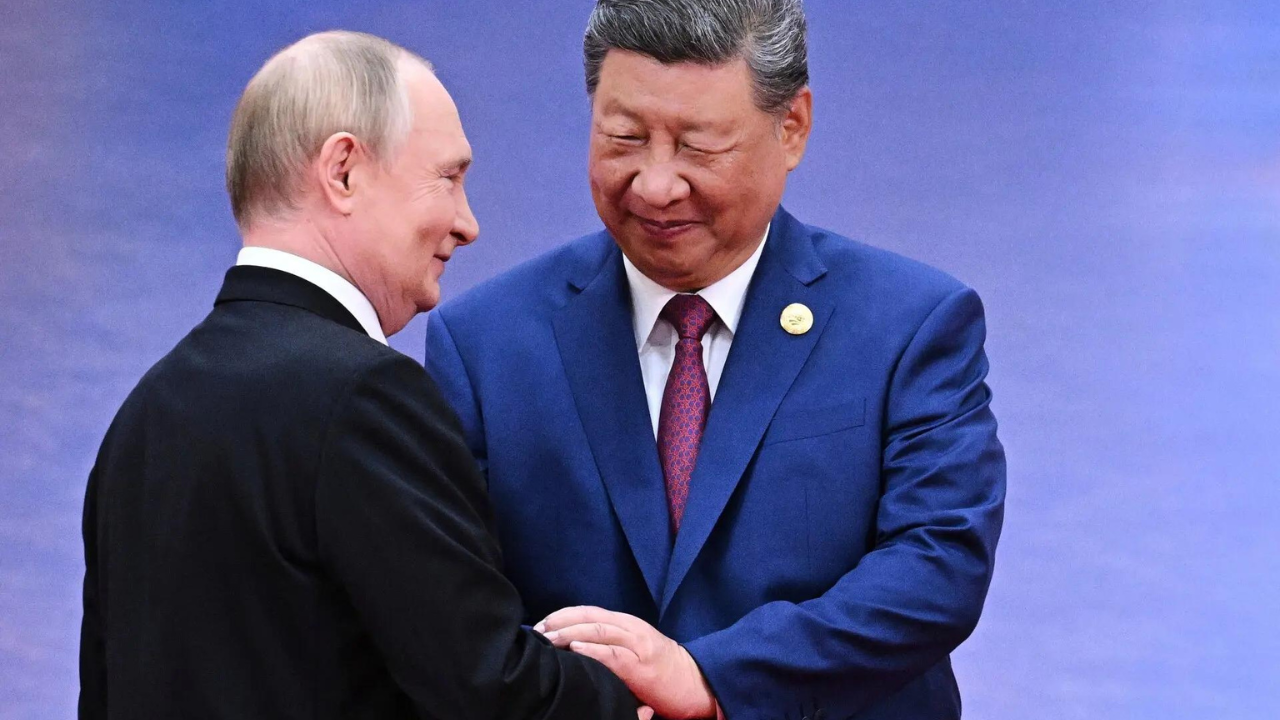
The tarmac at Beijing Capital International Airport has a specific kind of silence. It is not the silence of peace, but the pressurized quiet of a stage before the curtain rises. On Tuesday, as the wheels of Vladimir Putin’s Ilyushin aircraft touch down for his 25th official visit to China, the air will carry the scent of jet fuel and the weight of a century. This is not a meeting of bureaucrats. It is a reunion of two men who have spent a combined four decades molding the world to their will.
Xi Jinping often calls Putin his "old friend." In the lexicon of Chinese diplomacy, that phrase is a heavy anchor. It implies a debt of history and a shared vision of a future where the West no longer holds the gavel. But beneath the smiles and the synchronized strides across the Great Hall of the People, a different story unfolds. It is a story of a junior partner seeking a lifeline and a senior partner calculating the exact cost of loyalty.
The Mechanics of a Handshake
When these two men stand shoulder to shoulder, look past the suits. Notice the posture. Putin arrives in Beijing seeking more than just a photo opportunity. He is looking for a vent. With the Russian economy increasingly isolated by sanctions, China has become the lungs through which Russia breathes.
The agenda is packed with technicalities—energy pipelines, currency swaps, and trade corridors. To the average observer, a phrase like "Power of Siberia 2" sounds like a dry engineering project. In reality, it is a massive gamble. Russia wants to redirect the gas that once warmed European homes toward the hungry industrial hubs of eastern China. It is a pivot born of necessity. For Putin, every cubic meter of gas sold to Beijing is a middle finger to the G7. For Xi, it is a way to power his nation’s growth at a steep discount.
Consider the kitchen table in a provincial Russian town. The appliances are now Chinese. The cars on the street, once Volkswagens or Toyotas, are now Cherys and Geelys. This visit solidifies that transformation. Russia is not just "pivoting" to Asia; it is being absorbed into a Chinese economic sphere of influence.
The Ghost at the Banquet
There is a third chair at every table during this summit, though it remains empty. It belongs to the United States.
The invisible pressure of Washington sits in the room like a cold draft. Xi Jinping is walking a razor’s edge. On one hand, he needs Putin to remain a viable counterweight to American power. A collapsed Russia is a nightmare for Beijing—a chaotic, nuclear-armed neighbor is the last thing a stability-obsessed Communist Party wants. On the other hand, China’s biggest customers are still in New York, London, and Berlin.
Xi cannot afford to let his "old friend" drag him into the abyss of secondary sanctions. This tension defines the visit. Putin will ask for more—more technology, more financial backing, perhaps more overt military support. Xi will offer warmth, rhetoric, and "unlimited partnership," but he will keep his hand firmly on the faucet. He provides just enough to keep Russia upright, but not enough to trigger a full-scale trade war with the West.
It is a masterclass in strategic ambiguity.
Power in the Periphery
While the cameras focus on the grand halls, the real action happens in the shadows of the "No Limits" partnership. This visit is about the Global South. By standing together, Xi and Putin are sending a signal to leaders in Brasilia, Pretoria, and Riyadh. They are pitching an alternative reality.
In this narrative, the "old world order" is a crumbling relic. They speak of a multipolar world, a term that sounds academic until you realize it means a world where human rights are "internal matters" and borders are negotiable for the strong.
Putin’s 25th trip is a victory lap of endurance. He wants to show the world that he is not the pariah the West claims he is. He is walking the red carpet in the heart of the world's rising superpower. To the undecided nations of the world, that image is more persuasive than a thousand State Department briefings.
The Price of the Lifeline
Dependency has a bitter taste. For centuries, Russia viewed itself as a European power, a grand empire that looked toward the Enlightenment and the palaces of St. Petersburg. Now, the center of gravity has shifted irrevocably East.
The lopsided nature of this relationship is the most human element of the summit. Putin, the former KGB officer who prides himself on strength, is now in a position where he must wait for Xi’s nod. China now accounts for nearly a third of all Russian trade. The Yuan is replacing the Dollar in Russian banks. This isn't just a strategic alliance; it is a fundamental restructuring of what it means to be Russian in the 21st century.
There is a quiet desperation in the speed of this integration. The Kremlin is trading long-term sovereignty for short-term survival. Xi knows this. He is a patient man, raised on the philosophy that time is the ultimate weapon. He is happy to wait while Russia becomes a resource appendage to the Chinese machine.
The Echo in the Hall
As the ceremonies conclude and the motorcades sweep through the restricted streets of Beijing, the world watches for a slip, a crack, or a revelation. We look for clues in the joint statements—carefully parsed sentences about "sovereignty" and "security."
But the truth is written in the silence between the words.
The two leaders will share a meal, perhaps a toast to their shared history. They will speak of a friendship that "has no limits." Yet, as Putin flies back across the vast stretches of Siberia, he will be looking out over a land that is increasingly dependent on the man he just left.
The red carpet eventually gets rolled up. The flags are taken down. What remains is a world tilted on its axis, where the dragon provides the fire and the bear provides the fuel, and neither truly trusts the other's embrace.
In the high-stakes theater of global power, there are no "old friends." There are only interests, wrapped in silk and steel, waiting for the wind to change.