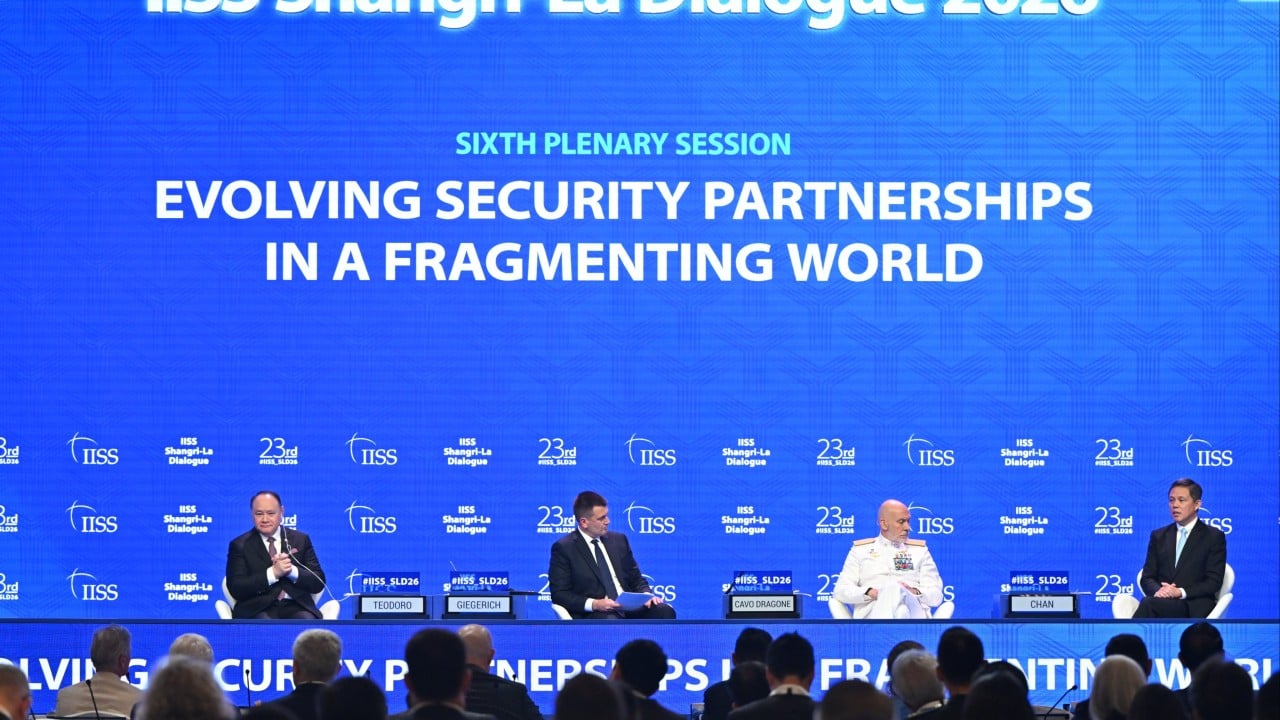
The annual gathering of defence ministers and military chiefs at Singapore’s Shangri-La Hotel has long operated on a comfortable fiction. For more than two decades, the assumption was that getting adversaries and allies into the same air-conditioned ballrooms would inevitably blunt the edges of geopolitical rivalry. That era is officially over.
When US Secretary of War Pete Hegseth stepped to the podium at the 2026 Shangri-La Dialogue and bluntly demanded "less Shangri-La, more ships, more subs," he did not just deliver a provocative soundbite. He delivered an obituary for traditional Indo-Pacific diplomacy. Washington has made it clear that it is done subsidising the security of wealthy nations that treat dialogue as a substitute for raw combat power.
The primary challenge facing the region is no longer a lack of communication. The challenge is a stark deficit of hulls in the water and industrial capacity on land. For years, regional capitals used the summit as an annual security blanket, convincing themselves that as long as speeches were being made, deterrence was being maintained. Now, the United States is shifting from a policy of reassurance to one of transactional realism. Alliances are no longer judged by the number of flags flying at a conference, but by the number of active naval formations ready to deploy.
The Cold Reality of the Trillion Dollar Pivot
The American security guarantee is undergoing its most radical transformation since the end of the Cold War. The US defence budget has breached the $1 trillion threshold, yet Washington is openly acknowledging that its resources are stretched thin by compounding crises across Europe and the Middle East. The message to Asian allies is unvarnished: the United States needs partners, not protectorates.
This is not isolationism. It is strategic exhaustion disguised as tough love. The Pentagon is building a denial defence in the Western Pacific designed to make any rapid, decisive military action by an adversary completely unviable. To achieve this, the US requires its regional partners to possess real military strength rather than relying entirely on the Seventh Fleet.
Consider the numbers that underpin this shift. The US Navy’s shipbuilding timelines are plagued by domestic shipyard bottlenecks, skilled labour shortages, and maintenance backlogs. Washington simply cannot build hulls fast enough to counter the massive naval expansion happening across the Taiwan Strait on its own.
The pressure is hitting regional capitals with varying degrees of force. Some have anticipated the crunch. Australia’s 2026 National Defence Strategy has directed more than 40% of its defence budget straight into the maritime domain. Canberra is undertaking a massive naval expansion, including nuclear-powered submarines under the AUKUS framework, Hobart-class destroyers, and new general-purpose frigates.
Other nations remain frozen in a state of strategic inertia. They face an acute version of the classic guns-versus-butter dilemma, operating under the assumption that their economic ties to Beijing would insulate them from security crises. That calculation has broken down completely.
The Gray Zone Vulnerability Nobody Can Talk Away
While the high-level rhetoric at regional summits focuses on catastrophic war scenarios over Taiwan, a much more immediate and insidious conflict is occurring below the surface. Over the past 18 months, attacks on subsea critical infrastructure have escalated to unprecedented levels. Subsea fiber-optic cables are the literal nervous system of the global economy, carrying over 95% of international data traffic and financial transactions.
They are also incredibly vulnerable. The threat does not come from a formal declaration of war, but from a growing shadow fleet of unregistered, flag-of-convenience vessels operating in the gray zone between commercial shipping and state coercion.
A single fishing trawler dragging a modified anchor can sever a cable, plunging a regional economy into digital darkness while maintaining plausible deniability. The legal and institutional frameworks governing maritime security are failing to keep pace with these tactics. Current national legislations and port state enforcement measures lack the teeth to penalize owners of these shadow vessels.
The technology to monitor this behavior exists. Satellite tracking, AI-driven vessel telemetry, and blockchain-verified registration systems are commercially available right now. The failure to deploy them is entirely political. Regional governments have routinely hesitated to pool their maritime intelligence or establish unified data fusion centers out of fear of provoking regional powers.
The Mirage of De-escalation Through Dialogue
The central flaw of the summit circuit has always been the belief that dialogue itself is a form of deterrence. It is not. While military-to-military communication channels are vital to prevent accidental miscalculations, they do not alter the underlying balance of power.
This reality was underscored by Beijing's diplomatic choices. For the second consecutive year, Chinese Defence Minister Dong Jun skipped the Singapore summit entirely, sending a lower-level delegation from the PLA National Defence University led by Major General Meng Xiangqing. This was a deliberate signal. Beijing is perfectly content to let mid-level officials engage in academic debates while its shipyards continue to churn out guided-missile destroyers at a record pace.
Southeast Asian nations find themselves caught in a tightening vice. They prefer a region defined by quiet equilibrium rather than public confrontation. Yet, the luxury of sitting on the fence is evaporating. When the dominant maritime power in the region states that it will no longer carry the disproportionate burden of regional defense, the strategic middle ground disappears.
The shift toward minilateralism—smaller, weaponized groupings like AUKUS, the Quad, and trilateral maritime pacts—is the direct result of larger regional forums proving too bloated to enact real security measures. These smaller coalitions are not designed to talk. They are designed to integrate fire control systems, share anti-submarine warfare data, and coordinate joint patrols.
The Industrial Bottleneck
If the future of Indo-Pacific security belongs to more ships and more subs, the immediate obstacle is industrial, not financial. You cannot buy deterrence off the shelf.
The Partnership for Indo-Pacific Industrial Resilience was launched precisely because individual national defense-industrial bases are failing. Building warships requires highly specialized steel, complex electronics, advanced propulsion systems, and a workforce that takes a decade to train. Japan and South Korea possess massive commercial shipbuilding infrastructure that could theoretically be leveraged for defense needs, but legal, political, and constitutional hurdles limit how quickly that capacity can be militarized or integrated with Western chains.
The brutal truth is that speeches do not build vertical launch systems. The Indo-Pacific has entered a deeply transactional era where security is measured in tonnage, missile depth, and industrial resilience. The diplomatic theater of the past two decades served its purpose during a time of relative stability. In an era of overt systemic competition, relying on talk is a luxury that regional security architectures can no longer afford.